

Category Archives: Collaboration

Seven Steps to Handling Interpersonal Differences

Keys to Negotiating with Power and Grace

By Daniel Robin

Make no mistake: resolving differences through negotiation is not a logical, linear process. However, this model can serve as a framework for staying on track and learning how and where things go wrong.

These seven steps progress from how you might want to begin an effort to resolve differences to how you’d want to complete that effort. Remember to prepare by writing down your goal before taking your first step. Enjoy the dance!

1. Establish a healthy context

Plan and select the right time, place, and atmosphere to negotiate … one that fosters mutual respect. Agree to groundrules, if necessary, so both parties feel safe and able to speak openly.

You’ll know if you picked the wrong time if you sit there during the conversation asking yourself “Why am I talking about this right now?” Make an appointment or simply wait until the right moment. Ask others to do the same.

2. Tap into motivation

Mutual motivation is prerequisite to effective negotiation.

If they have a positional or situational power advantage, appeal to their self-interest (match their values) to motivate them to join you at the negotiation table and grant power to the conversation.

If you have more positional or situational power (you’re “one up”), temporarily suspend that privilege to “empower” the other party through inclusion. Share the commodities of power so they actively participate in getting to an agreement. Be direct and forthcoming. Speak plainly. Clarify your intention to “work it out” and ask for them to hold you accountable to standards and guidelines.

People use power differently — passive avoiders hold onto interpersonal power (they might need it later), authoritarians use power over others, accommodaters give it up, while collaborators go for power with others, or “shared power.” What’s your most and least familiar style? Who are you working with and what’s their natural style? See the Interpersonal and Leadership Styles discussion for details.

3. Remember your Goal

Before the conversation begins, ask yourself “What do I want?” If what you want is likely to be unacceptable to the other person (your “position”), then ask yourself “What would it do for me if I had that?” Be clear about how you’d know if you achieved your desired outcome.

Because you write down your goal in terms of wants, actual needs (interests, motivation, core values, or criteria), options and alternatives, all you need do during the discussion is to recollect what you wrote down and then ….

4. Discover their Goal

Build rapport as you gather information about what they want. Be curious and interested. Focus first on understanding and defining any problems or issues, then shift to pinpointing their priorities and interests. Ask “What would that do?” “how,” and “when” questions — avoid “why.”

5. Accept and Validate their View

Accepting it doesn’t mean you agree with it or obligate you to share stated interests. Before asking them to understand your view, make sure you understand & can verify exactly how it is for them. Surface any “Yes, but…” resistance. Match and mirror to get to the heart of any issues. Remember: you know your own goal (Step 3), so you’re free to first be fully on their agenda.

6. Build a Bridge

Use what you’ve learned to highlight areas where you agree. Identify your shared concerns against your shared separation. Shift out of “you against me” and into “us against the problem.” Lead toward a mutual understanding of “what we both want.” Moving with any resistance you encounter (steps 4 & 5), propose possible creative alternatives (“What if I …, would you …?”) to clarify conditions of satisfaction.

Brainstorm several options that would satisfy mutual interests. If possible, include ideas from multiple perspectives (at minimum, theirs and yours) to build toward a blended “best of both worlds” approach.  Consider how this problem, or one similar to it, was previously resolved [by anyone]. Do not squander this opportunity to find a solution on proving that you are right and they are wrong or building an adversarial alliance with others who happen to agree with you.

Two useful questions at this stage are “How might we work it out so that your needs and my needs are both met?” or more directly “What would it take … [to satisfy both our concerns]?”  Answers to one or both of these questions will open up a variety of ways to reach agreement. Don’t pick one right away, just list them.  Give yourself (and your negotiation partner) time, breathing room, and a chance to fully consider creative ideas.

7. Walk Across the Bridge

Collaborate in selecting the one, best alternative to satisfy shared interests. You’ll know you’re on the right track when one of you says “Which one of these options would work best for you?” or if someone checks to see if there’s anything else to talk about.

Close the session by verifying understandings and agreements reached, including any further action, inquiry or follow-up steps. Recognize and appreciate cooperation as well as clear boundaries.
As you practice using these steps, you will open up a variety of new ways to form agreements, show respect, and preserve — perhaps even strengthen — your basis for relationship.
The Dynamics of Non-Adversarial Negotiation

By Daniel Robin

Joe had done his homework: “I propose that we put 25% of our training budget to work on giving people listening skills and that we postpone the management training course we’ve been considering.” Joe had worked out a detailed set of arguments about why his was the right direction. As usual, his manager saw it differently: truth was, everyone knew how to listen (even if they did it poorly), but few, if any, seemed to know how to manage their workload.

The boss began to disagree by saying, “Well, Joe, I’m sure you’ve got your reasons, but let’s hear from other people … does someone have a different idea?” Kathy, facilitating the meeting, spoke up immediately: “I’d like to hear Joe’s reasons before we pile on other ideas…. Joe, how would listening skills help us address our department’s key concerns?”

How does most negotiation work? Most negotiators put forth a strong proposal, listing their reasons for why it must be so, and then wait for a response or counter-offer that will satisfy their concerns. If that negotiator is you, I’d like to suggest a different approach. And if you’re dealing with another negotiator who has not read this article, here’s a surprising way to get what you want.

Universal Law: People Negotiate Better When They’ve Been Understood

When someone puts out their proposal, that person is least available psychologically to hear a counter-offer from you at that moment. What they really want to hear is something that indicates that you understand and can see the value and intent behind their proposal. Start by finding something to agree with; something that you recognize as valuable. Then, if you intend to make a counter-proposal, do so only after you’ve found and helped them to see a potential weakness or inadequacy in theirs.

Buying Time

While you examine their proposal, you buy yourself time to identify and discuss what works and what doesn’t. This gives you a chance to present your own ideas in the context of having understood the pros and cons of theirs. Without that context, there nothing more than a power struggle, jockeying for position, attempts to undermine and put each other down.

Instead, put the person up (and put parts of their proposal “in perspective,” once you’ve understood it). Trying to beat the other person is an ineffective win-lose game that comes from the human tendency to compete and win at their expense. It make be satisfying in the moment, but rarely works out well in the long-run.

Competitive Urges?

The best negotiators use their desire to win and compete to do what I call “coopetition.” A dumb word, but a great strategy. Out of the five strategies for handling differences (September 1995 Healthy Workplace), negotiation involves either collaborating, confronting or compromising. Compromise is either a last resort or simply “not an option” if you’re committed to win-win or no deal (for example, who takes custody of the children?). “Coopeting” turns confrontation into an art form.

Confronting gently enough can open up a collaborative conversation to “work it out for mutual gain.” Competitive urges that don’t include the other person’s interests, however, can lead to win-lose and damage, so the key is finding a way to confront that allows the person to extract your highest intentions.

This is not complex. You can simply state your intention at some point … “I’d like to collaborate on finding solutions to this.” or “I’d like to go with your proposal, and what that would take for me is ….” Other forms of coopetition include studying and learning about your negotiation partner’s interests so that you can explain what they mean better than they can. That depth of understanding will take the wind out of any would-be competitor’s sails. Arguments aren’t possible when you pay close attention to the other party’s interests, because there’s only one place left to go: understanding what you want.

Try it and see. Understanding the other person isn’t usually considered a power tool. You may be surprised to learn that your most powerful tool in negotiation is your compassion.

Getting your Way through Non-Adversarial Negotiations

Getting Your Way through Non-Adversarial Negotiation.

By Daniel Robin

When you want something and the other person doesn’t, how does the conversation usually go? Most negotiators put forth a strong proposal, listing their reasons for why it must be so, and then wait for a response or counter-offer to satisfy their interests. Does this work? If that negotiator is you, I’d like to suggest a different approach. And if you’re dealing with another negotiator (who might even read this article), here’s a surprisingly simple way to get what you want.

Universal Law: People Negotiate Better When They’ve Been Understood

When someone puts out their proposal, that person is least available psychologically to hear a counter-offer from you at that moment. What they really want to hear is something that indicates that you understand and can see the value and intent behind their proposal. Start by finding something to agree with; something that you recognize as valuable. Then, if you intend to make a counter-proposal, do so only after you’ve found and helped them to see a potential weakness or inadequacy in theirs.

Buying Time

While you examine their proposal, you buy yourself time to identify and discuss what works and what doesn’t. This gives you a chance to present your own ideas in the context of having understood the pros and cons of theirs. Without that context, there nothing more than a power struggle, jockeying for position, attempts to undermine and put each other down.

Instead, put the person up, and put parts of their proposal “in perspective”– once you’ve understood it. Trying to beat the other person is an ineffective win-lose game that comes from the human tendency to compete, to “win” exclusively rather than inclusively. Who ever said we can’t both win?

Competitive Urges?

The best negotiators use their desire to win and compete to do what I call “coopetition.” A dumb word, but a great strategy. Out of the five strategies for handling differences (September 1995 Healthy Workplace), negotiation involves either collaborating, confronting or compromising. Compromise is either a last resort or simply “not an option” if you’re committed to win-win or no deal (for example, who takes custody of the children?). “Coopeting” turns confrontation into an artform.

Confronting gently enough can open up a collaborative conversation to “work it out for mutual gain.” Competitive urges that don’t include the other person’s interests, however, can lead to win-lose and damage, so the key is finding a way to confront that allows the person to extract your highest intentions.

This is not complex. You can simply state your intention at some point … “I’d like to collaborate on finding solutions to this.” or “I’d like to go with your proposal, and what that would take for me is ….” Other forms of coopetition include studying and learning about your negotiation partner’s interests so that you can explain what they mean better than they can. That depth of understanding will take the wind out of any would-be competitor’s sails. Arguments aren’t possible when you pay close attention to the other party’s interests, because there’s only one place left to go: understanding what you want.

Try it and see. You may be surprised to learn that your most powerful tool in negotiation is your compassion and ability to understand.

When to Engage, When not to Engage

by Daniel Robin

Ever notice that with some people you can sit and rationally discuss how differently you see things, and nobody gets hurt? It might even be fun! Yet, with others, particularly those closest to us, the small stuff quickly becomes big stuff. What makes the difference?

When you think back on the successful disagreements you’ve had in your life (you know, the ones that ended without loss of hair or dignity, or that actually led to a creative solution), what do they have in common?

Because conflict is such a “growth industry,” healthy workplace relationships are as essential as they are unusual. To compensate, this article will highlight tools to help us decide when to dive in and when to observe, detach, or carefully step around the “hornet’s nest.”

Setting Clear Boundaries

We use our personal power to set and maintain interpersonal boundaries. Most of us have patterns of conditioning that determine our responses. For example, if someone comes at you with a sharp stick (verbally that might sound like “I told you that wouldn’t work, and look what you did!”), is that a good time to engage? Depends on how you engage.

Conversational Aikido suggests that rather than taking an adversarial or defensive stance, rather than picking up a sharp stick of your own and preparing for counter-attack, you can move with the attacker’s energy. “So you told me what wouldn’t work? …” and “Somehow, that got you a result you didn’t want?” If this apparent plot to make you wrong continues, asking “What upset you most about it?” will give them nothing to push against.

However, if that person’s pointed attack hooks you into retaliation, you may want to use your personal power to protect the relationship.

Release Thy Enemy

Interpersonal differences that lead to fights are feedback about something we’re doing (or not doing). Could it be that we’ve had lots of practice in how to escalate, but not nearly as much in ways to de-escalate? It takes “two to tango,” but it only takes one person to stop being adversarial.

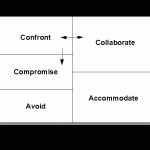
There are two practical ways to not engage (accommodate or avoid) and three others to engage, as shown below.

Strategies for Resolving Differences: 

Strategy and Theme

Avoid — “Leave well enough alone”

Accommodate — “Kill ‘em with kindness”

Confront — “Might makes right”

Collaborate — “Two heads are better than one”

Compromise — “Split the difference”

Using the earlier example of a verbal sharp stick, you can use avoidance to disengage, as in “I’m not available for this conversation right now.” Or you could constructively accommodate by refocusing only on what they’re wanting for the future with “And what do you suggest we do differently next time?”Most of us rely on one or two of the five and would benefit from practicing use of the others. What are the situations when each is the right choice?

When Not to Engage

Avoiding is appropriate when there’s no way to win or there needs to be a cooling off period.

Accommodating involves listening and accepting without resistance, effective when the issue is less important than the relationship. Accommodation on minor issues which are important to others are gestures of goodwill and are a way to make deposits in someone’s “emotional bank account.”

Not engaging is different than resisting or being defensive. It can be a conscious, deliberate choice to not struggle, to protect the relationship, or to stop adversarial, win-lose dynamics. Rather than “meeting them at their own game,” call the game over and arrange to play another day in some other way.

When to Engage

On the other hand, do you sometimes have trouble taking a firm stand, even when you see the need? That could a sign that you rely too heavily on avoiding or accommodating.

Gently confronting the other person and assert your view might sound like “I didn’t use your idea because … and how can we work it out so that you can contribute here and I still get to decide how to do my job?,” which leads to collaborating on a solution. If you find yourself often hurting other people’s feelings or stirring up hostilities, consider using the other four strategies.

Collaborating might involve working together to generate win-win alternatives to resolving the issue. If you rely too heavily on this one, you’ll spend time discussing issues in depth that do not seem to deserve it.

Compromise, used to get to quick resolution, involves bargaining and mutually giving up something to reach settlement. “If I use your idea will you stop bugging me about it?” It doesn’t really solve the core issue, but it does quickly handle part of the problem and prevents further escalation.

When you know people, and you know yourself, you’ll be able to quickly assess if you can “get there from here.” To find that balance point where boundaries are neither too rigid nor too fluid, consider varying your approach by practicing each strategy for 3-6 weeks, then they’ll be available when you need them most.

When to Negotiate Directly

Lastly, negotiation makes sense whenever you can make the other person an offer or proposal that they would find more attractive than their next-best alternative. In addition….

  • When it’s up to you, when there are no better alternatives
  • When the task or issue is important (if it’s not, either let it go or lead strongly)
  • When you’re not so fully invested in a position that you can explore options
  • When not negotiating would cost you; when you have something to gain
  • When there’s been a misunderstanding; when there is no understanding or agreement
  • When you’d like the satisfaction, peace of mind … from handling differences openly
  • To be a model: to demonstrate what effective negotiation looks/sounds/smells/feels like.

Helping the Emergence of Co-operative Work

By Daniel Robin

Whether you’re a group manager or executive, member of a dedicated work team, or an entrepreneur out on your own, you’ve probably noticed an increased reliance on collaboration and co-operation to get things done. The days of the lone wolf or the aggressive, cut-throat bully are over. Effective managers have realized that treating people as mere factors of production isn’t very productive.

Yet, despite the importance of having whole human beings showing up for work, most organizations still talk of empowerment but struggle to achieve it. Step one: commit to building a culture where people at every level are given the tools and training, the skills and strategies, the authority and responsibility needed to share power, build trust, and get recognized. Once the commitment has been made, don’t say much about it, just make it happen collaboratively and highlight the results as evidence of the commitment.

Letting Go of Control

Leaders of hierarchical organizations have resisted “handing over the keys to the car” because they’re not sure if we can drive. The task is to let go of control in favor of new structures and agreements. Be gone layered hierarchies built on information, bureaucracy, and power over others; welcome instead structures that help transfer knowledge and pertinent performance data to those who need it. Letting go is perhaps the hardest change there is, one that often elicits fear, anger, and ambiguity. That may explain some of the chaos and uncertainty of late.

The problem with upper management’s ambiguity is that it can look and smell like a trick, like yet another power trip — and people can mistake it for insincerity and claim to “smell a rat.” Fear and incongruence ain’t pretty. If people pick up a message of false empowerment (“You are now empowered. Trust me on this. Now get back to work.”), when the laughter subsides, cynicism remains to fill the gap left by the empty promise.

Building a Trust Culture

Even when employees are given all the power and responsibility they can handle, management’s motive is suspect: the “gift” seems conditioned on improved performance (guess what: it is!). This equal treatment must be acknowledged as a right, not a privilege, not something with strings attached, as if the cars keys can be yanked back for the slightest infraction.

At the core of this changing employment contract is an unspoken promise: “You handed us the new gameplan, now coach us to play the game.” This means that new skills and structures must displace the old autocracy. The role of management is changing from managing others to providing an environment where people can self-manage.

To make the shift as smooth as possible, people in team-based organizations are learning how to provide such an environment with coaching.

The Art and Practice of Coaching

Similar to a sports coach who aims to bring out an athlete’s best performance, coaching in a workplace setting helps guide people to their own answers, making “empowerment” a reality.

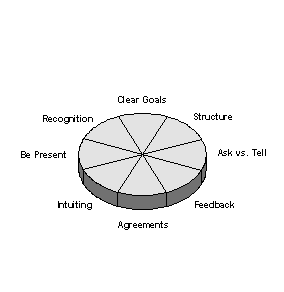
We’re often asked what constitutes coaching versus other styles or approaches. From the viewpoint of the person doing the coaching, there are eight essential elements that, taken together, differentiate coaching from other methods, like teaching, consulting, or counseling. The elements are shown in the wheel below:

1. Be present: Before coaching someone, pay careful attention to the signals that indicate rapport. The more you can be present, the better you will be as a coach. It would be a mistake to push through resistance or to coach when you are distracted. Instead, being present means being on their agenda, available to what they’re up to, able to let them know you understand their situation, challenges, resistance, fears, etc. Like rapport, this element is foundational to all others.

2. Clear Goals: Assuming that you and the client are clear on what’s wanted would be a mistake. Set clear immediate goals and long-term direction with “What do you want?” and “How will you know when you’ve got that?”

3. Ask vs. Tell: Giving unsolicited advice is not only disempowering, it’s unnecessary. Resist the temptation to “give them a fish;” instead, teach them how to fish for their own answers. If you feel compelled to offer advice, it can be packaged in a way that puts the person fully at choice and in charge. For example, try “I have an idea that you might find useful; mind if I check it out with you?”

4. Agreements: Unclear or incomplete agreements produce misery and suffering. “Oh, you thought I meant this Thursday!?” This also includes effective agreements for how they want to be coached. Clear agreements can contribute to setting an atmosphere of mutual respect and shared power. Effective coaching turns up the volume on accountability to agreements, replacing the need for “command and control.”

5. Recognition: Being present provides some recognition, while verbal acknowledgement builds the client’s enthusiasm and positively reinforces what’s working. Warning: Do not fake praise. The skill is in finding out what it is about this person and their performance that’s praise-worthy; be sincere and generously encourage what’s wanted.

6. Feedback: Let their mistakes be their best teacher. Live by “no failure; only feedback” and only give constructive suggestions for improvement. Learn to gently confront areas that need attention. Separate the person from the issue. Provide both observation and interpretation so you can openly discuss differing perceptions.

7. Structure: Instead of allowing fire-drills and chaos to rule the day, design reasonable action steps to reach achievable goals. Structures are for supporting, not burdening, the client. They assist the client to remember their commitments, to systematically assess and adjust priorities, to increase their capacity to focus, and to track progress for on-going learning and process improvement.

8. Intuiting: The opposite of structure. Note that intuition is different from opinion or interpretation. Intuition usually comes from a “gut feel” or other body signals. An effective coach knows when to throw away the plan, be pragmatic, and how to politely invade or challenge the client’s assumptions to prevent catastrophe.

Most high-functioning people already possess skill at coaching — they just need to understand how and when to use those skills to build trust with the client. Managers and team members gradually add new coaching skills and distinctions to their interpersonal repertoire.

The ultimate goal is to condition the client to use their own resources when you’re not around. And if you think being coached feels good, check out being one.

Advantages of Coaching

For the Coach

× Better employee performance

× You don’t have to have all the answers

× Shared responsibility, which frees you up to innovate, focus on building relationships

× Unleashed creativity

× Agreements upheld more often

For the Client

× Better results with less effort and less stress

× Employee feels more intrinsically motivated and in charge

× Increased commitment to doing their best

× Increased self-esteem and confidence

× More creativity and support for innovative problem-solving.

Recognition and Accountability in the New Workplace

By Daniel Robin

“Don’t we have to send out surveys to test the waters before determining an advertising budget?” the new boss asks.

“Nah, the Web isn’t like that. And since when are you an expert in marketing?” the marketing manager asked her boss.

“That’s why you’re here, alright. To keep me in line. And if my business degree means anything, it’ll come in handy to help you measure the impact of this hyper-social stuff.”

“You gotta deal, boss!”

… and so the strategy to include social media marketing eventually became a reality.

When to Assert, When to Collaborate

The old management approach was “Do it my way or pay the price… questions?” In the new workplace, employees are collaborators, suggesting that we work together toward mutual benefit. And yes, the increased freedom and autonomy relies on building in accountability systems.

As we mentioned in the previous article, some extremely successful companies (Hewlett Packard, for instance) provide tremendous operating freedom to their employees. Management gives broad operating guidelines, and lets people flourish or hang themselves in the process. Not every business can succeed with this approach. There’s a balance point between telling people what to do and giving no direction at all, relying on self-organizing systems and chaos to produce the desired results.

How Good Can You Stand It?

New workplace leadership tends to focus on primarily staffing and resource issues, coaching, and clearing obstacles when a situation is outside their staff’s sphere of influence. Perhaps management’s new charter is to get out of the way….

But why is it that some employees inevitably “wig out” with all this freedom? Have you noticed that some folks apparently can’t handle being in charge of their own life … it makes them uncomfortable, like they’ve just been given the keys to a powerful race car but fear they might lose control or something worse. There are often a small number of people who bring unresolved issues with authority to the workplace, and for whatever reason, act out their personal history on the job. The remainder of this article explains how to deal with such situations on and off the job.

Handling Workplace Crud

To effectively manage and motivate people when there is a policy non-compliance issue, or when serious mistakes are made, remember to focus on recognition and praise in balance with any corrective measures and “feedback.” Ideally, give 80% recognition and 20% feedback and constructive criticism. The only exception: when you’ve tried all other approaches, including making a direct request, and you get no cooperation. At times like this, explain the consequence – that you have no choice but to issue a verbal written warning or other disciplinary action – so there is a proper record.

Remember, if you feel angry, outraged, or like placing blame, somehow get that negativity off your chest and out of the way before opening the conversation. Unless you have incredible emotional restraint (skills as an actor, basically), you may want to privately go fully into what we call the “Blame Frame” (also known as venting) in order to acknowledge to yourself what the problem really is. Remember that the person is not the problem. Even if you think they are “problematic,” it does no good to act from this assumption. It just creates a right/wrong power struggle and useless loops that go nowhere in a hurry.

Why get anger and emotionality out of the way? Because any heavy “parental vibe” will likely trigger them into fear or defensiveness, and will not help you correct the problem in an open and collaborative way. Safety is essential. It works better to assume they already feel bad about the situation (or they will soon), so instead give them every opportunity to voluntarily make an agreement that solves the situation for future.

Conversationally, you might ask the other person “So, what can be done to make sure this never happens again?”

Gaining Cooperation is Key

Help them feel supported and safe enough to openly acknowledge the problem and their part in it. Even if they are unwilling to take responsibility, or they feel it is unfair, having them feel bad (blamed and shamed, criticized, put down…) must be reserved for the absolute last choice as a motivation or persuasion tool. To do otherwise will create a struggle where the other person waits for an ultimatum (like disciplinary action) to begin to improve.

Rather than relying on pleasure (reward and recognition) or pain (criticism and consequence) to motivate people, persuade and negotiate, perhaps causing what psychologists call “cognitive dissonance” – what will cause the person to either take action or try to justify their behavior to resolve the dissonance. If you can show the other person “what’s in it for them” and push back on some of their limiting beliefs, you may have a greater influence on their behavior than empty promises or harsh consequences.

Assume from the start that everyone does the best they can with what they have, hold them to as high a standard as you hold yourself, and fully expect them to succeed … and, eventually, they will!

Organizational Pathways: Part 1

Waging Peace in the Workplace

By Daniel Robin

With the increase in work force diversity, emphasis on teams, and the new-world-disorder — also known as chaos — sooner or later, we all get into conflicts that just don’t resolve, even with a Ph.D. in active listening mode. Calmly sitting down to “talk about it” can be frustrating when there are hidden agendas, turf wars, or fear patterns in the culture and in the people involved.

So what if you give it your best shot and nothing comes of it? A willingness to deal with an issue — even if the effort is clumsy at first — is far better than the insidious patterns of avoidance, denial, passive-aggressive indirectness, plotting how to get even….

In the gap between theory (what we know) and practice (what we do) lives an astounding fact: our culture has developed remarkable tools and technologies for handling virtually any type of dispute; however, the ones that work are seldom used, and the ones that are used seldom work.

Finding Alternatives

I’m surprised how few people have even heard of “alternative dispute resolution” (ADR). Here’s a quick quiz:

What is arbitration and when would you use it?

Under what circumstances should you use a “third-party neutral” (hint: before you begin to unravel emotionally) and

When is it best to handle a situation yourself?

What does mediation have in common with arbitration? What are the differences?

If you know the answers to these questions, you probably practice ADR for a living. Unfortunately, our schools are only just now providing this practical information – so vital to success in today’s workplace.

It is simply not true that the only way to deal with conflict is to provoke more of it. Even in the most difficult situations, the other person isn’t necessarily our adversary. Our congested court system is hardly a place to bring important, emotionally-charged issues — business-related or not. And yet, despite the uncertainty that goes along with giving up control, power and major dollars to someone else to work out a legal “remedy” (notice it’s not called a solution), we still rank as the most sue-happy culture in the world.

How ADR Applies to the Workplace

What makes the workplace unique and challenging is that most relationships can be strengthened through collaboration, and yet, few people seize this opportunity. Perhaps it’s just too darn risky and uncomfortable to surf the chaos of including other views and perspectives before deciding what to do with them. It certainly seems faster and easier to reduce options to a tidy twosome (“my way or … “), then you can pick the least lousy alternative. The phrase “What are some other options?” can work wonders.

It takes careful and confident facilitation — and sometimes it takes not being in the middle of the issue — to broaden the focus just enough to generate and explore options without getting derailed. The facilitator needs the flexibility to move with the other person or group, the focus to keep working toward goals, and the smoothness not to interfere with communication in the process.

California is ripe with caring professionals who would like nothing better than to have everyone live in peace and harmony. And yet [Excuse me while I yell at my cat. Now, where was I?], we cannot drift too far from getting business results, or we’ll have no workplace to be peaceful in.

Above all, workplaces need to be fun. Wage peace and we’ll enjoy the dividends of a wage increase with profit for all.

Four Pillars of Agreements

In order for people to honor agreements in ways that get the desired result, the following four conditions must be met. If any one of these factors miss the mark, chances are good that something will go wrong.

Clarity: clear about the goal and the complete set of “conditions of satisfaction” (values, criteria, expectations)

Commitment: Solid “yes” representing unwavering alignment to give one’s best effort. No unacknowledged resistance. Self-talk: “My word is my bond.”

Capacity: This is about one’s “bandwidth,” real-world ability to see it through to completion, to stay focused over time, to clear the path. If one’s plate is so full that the new agreement won’t fit, the capacity to get the job done is low. Self-talk: “This fits for me.”

Competence: Willingness to be accountable and follow through; accepts full responsibility and provides evidence through “how will I/we know?”

The following articles provide further background on building a organization where people are productive, do their best work, and are resilient in the face of change.

Building a Workplace Based on Agreements

Successful workplace cultures are based on agreements. Here’s some suggestions on how to get “from here to there.”

The Art and Practice of Agreement

How to build a workplace based on clear and complete, voluntary agreements