

Category Archives: Conflict Resolution

The Meaning of your Communication is Its Effect

By Daniel Robin

In communicating with other people, what matters more: what we intend to convey, or the actual response we get? Who is responsible for your communication? The meaning of our communication is not what we think it means. It is based on the response we get from the other person. It is pointless to insist on a meaning that is lost on the listener, especially when the response you get is entirely separate from your intent.

For example, we might intend to pay someone a compliment, and if they take it the wrong way, what can we do about that? Would it make sense to argue that they should just take it as a compliment and chill out? Perhaps a better approach is to notice that for them to receive it, compliments must be delivered differently.

Choice Is Better Than No Choice

If we become conscious of how we produce responses in other people, we will have additional choices. If we’re triggering an unintended response, understand how it happens. The trigger may be as subtle as tone of voice or a certain facial expression; these non-verbal cues say more than our words. If the relationship is important, let the other person know you want to understand what they are getting from you.

For example, a client of mine, call her Kathy, found herself repeatedly in a conflict with a coworker. She speaks and acts in ways that trigger the other person to get instantly upset and frustrated. This pattern has been going on for quite some time. They are both to the point where they try to avoid each other — a useful coping strategy, but not likely to resolve the conflict.

To start, I suggested that she discover what she does (or doesn’t do) that leads to these strong reactions. My suggestion doesn’t imply that she is doing anything wrong. It’s only about the response she gets: use it as feedback. Once she owns how she influences the interactions, she can decide to either continue doing the same thing (and hope that the coworker or the circumstances change), or she can try something different.

I Said, She Said

Currently, Kathy’s pattern is an automatic “calibrated loop”— similar to how “dysfunction” patterns get set up in family systems — you say this, and they say that, and you say… and the next thing you know nobody is listening and there’s that all-too-familiar feeling again. So, what we can do is remember our goal, and look for alternative ways to get there. Does it make sense to wait for them to change, to act more cooperatively, to notice how inappropriately they are behaving?

Famous definition of insanity: doing the same thing over and over and expecting a different result.

Sharing Power in Communication

Communication, like driving in traffic, is a cooperative system. Kathy can produce an instant reaction in the other person with just a glance. Isn’t it amazing that we have such power to influence others?

Contrary to what you might expect, the person who has the most flexibility in a communication situation will generally have the most control over that situation. How flexible are you? If there’s a behavior you cannot generate — for whatever reason — there’s probably a response you won’t be able to elicit from that other person. And if the meaning of your communication is the response you get, that behavior might be exactly the one you need to produce.

Try Anything Else

If you’re having a tough time influencing someone in the direction you want to go, trying flexing over to their world and first “meet them where they are” (see previous article). If you’re producing an unintended result, remember your goal, and then get some feedback about how you are getting that result. With that feedback, you can plan out different ways to move with the other person toward your desired outcome.

There’s a saying: when what you’re doing isn’t working, try anything else. When you maintain a state of curiosity, you can try doing something — anything — different, perceive the response, and learn from it. Did you move toward your goal? Ask for feedback. Keep experimenting.

Workplace Power Dynamics: Part 2

Fun Things to do with Power

By Daniel Robin

Last article kicked around the dynamics of interpersonal power; this one applies these dynamics in some sticky situations. Because power is a central issue in working out disputes, this theme will culminate some loose ends that when mushed together can be used to gain leverage, cooperation and results.

Two of the toughest situations are when the other person thinks there is no conflict, or situations where the conflict is a given, but resolving it seems hopeless. This has probably never happened to you, right?

You Are Not Alone

There’s more power with two people looking at “the problem” from the same side of the table than if all the energy goes to escalating our right to be heard, as if our position is the most important thing. If you want resolution, your position must be seen as equally important to theirs. By being willing to first understand and accept the validity of the other person’s point of view, regardless of whether or not we agree with it, we can escalate understanding and acceptance — and eventually get to an agreement.

Sounds ideal, perhaps even idealistic? Maybe so, but it works! In all interpersonal disputes, the key to resolution is to establish a positive conflict management frame in which the other party can feel secure enough to deal with the conflict (or admit there is one). That probably involves bringing the situation to their attention in a way that balances clarity about what you want with consideration for their self-interest.

What’s Good for the Goose is the Gander

Everyone I know operates out of self-interest. Well, maybe some people operate out of a sense of universal oneness, but they don’t pay rent, so whatever. If you want resolution and they don’t, you’ll want to find some leverage. The question is, how can we get them to tell us what would motivate them, what’s in it for them, what would work?

If you have some basis — any basis — for an ongoing relationship, your relationship with the other person can be the leverage that buys you new options, as it contains power to get both of you to a better agreement. Caveat: you must handle it non-adversarially. If you go for threats and consequences, you’ll automatically lose out.

Walking the Balance Beam

Since fighting gives power away, what are the “moves” that retain the shared available power and build it toward a new agreement? The first move, if you haven’t already done so, is to look inside and check to see if the conflict is internal — a problem that you are feeling inside yourself that may not really involve the other party. Self-respect is the gateway to respecting and collaborating with others. Some people believe that all conflict is a result of internal confusion about what we want or who we are. Think about it.

Assuming there are inherent power differences, or if both parties do not share the same information or access, it might be in one party’s best interest to reach resolution, but not the other’s. How can you establish a level playing field? In our workshops, we teach a seven-step dispute resolution approach that addresses power imbalance. That doesn’t guarantee resolution, but it does increase the possibility. Dance step #4, goes as follows:

How to Equalize Power

Offer or request that positional power temporarily be put aside. For example, a woman owner of a company, white male supervisor, or a parent can temporarily deny privilege and “power over” in favor of “power with” in order to exploit the common interests of both parties — not exploit each other. You might choose to share or accept some key information that the other person needs to be willing to reach resolution. What’s your bottom line? What’s theirs? Get together and talk about it.

From here you need only identify your shared interests and weigh them against any differences.

Turning Opposition to Understanding through Aikido

The Reactionary Tango

By Daniel Robin

Communication is like a dance … when it works, there’s a blending and cooperation that requires awareness and skill. Fortunately, only one partner needs to be skilled (though it takes lots less work when both are).

We all bring expertise at some of the “dance moves” of interpersonal relating. Some people hate chit-chat, while others can’t seem to get to the point. When does your personal communication style work, and when does it get you unintended results?

Unlike dancing, however, business communication always holds a purpose beyond the dance itself. Whether your partner is a communication klutz or happens to be a powerful negotiator, learning new steps allows you to realize that purpose smoothly, with minimal toe-tromping.

Waltzing with the ‘Enemy’

When the other person gets inflammatory with “If you don’t start putting in some effort here I’m going to …,” or “I’m sick and tired of you always …,” or “I told you …,” how do you react? Do you suddenly feel like they’re doing raggae while you’re trying to swing? Whose problem is it?

Even if you feel attacked, you can “release” your enemy stance by not getting caught up in the attack, by not getting hooked into a dance you’d rather not do. How? Don’t react, respond with a remarkable dance step borrowed from the martial art of Aikido.

It works like this: Notice at what point you are being attacked. Let’s say they’re out to make you wrong. Rather than struggling with the apparent focal point of the attack from defensiveness, polarity, or as their adversary (“I think I’m right …,” or “You don’t know what you’re talking about …”), move off the line of the attack and join shoulder-to-shoulder with the attacker. You might reply, “I don’t think so, but let me look at it from your point of view,” or “I’m interested to learn why you think so,” or even “What’s your intention here? And what would that do for you?”

A Modern-Day Hokey Pokey?

Metaphorically, if the attacker just grabbed your arm, rather than focusing on the arm (the issue or the point of attack, where moving your arm would cause a struggle), instead, leave the arm alone and pivot your entire body alongside the attacker’s arm. From this position, you are out of the way of the direction of the attack, and in an excellent position to use the attacker’s energy. You are literally seeing the attacker’s point of view from its source, and therefore in an ideal position to avoid escalation and resolve the conflict.

Even if you’re not being attacked per se, this approach can be used to leverage the other person’s interests, intention, motivation, anger or resistance to find a mutually satisfying outcome.

I’m Sorry, but I Wasn’t Listening

Doesn’t it seem like the world has become very noisy? Not just shrill ringtones, 911 sirens, and other signals that we live in a so-called civilization, but more the continual assault of daily information, spam and social media (if you find the benefits outweigh the BS) — it’s no wonder we often stop listening to ourselves and to each other. Even with the awareness that our health requires us to understand and be understood by the world around us, we sometimes forget how powerful it is to give someone our ear.  AI is not going to be helpful in this regard — it is really just an echo chamber and illusory.

When your goal is to get your own point across, the first and most important move you can make is, ironically, to listen. Clients report that it “works like magic” to get on the other person’s “wavelength” by gently drawing them out. Just the intention of understanding them first creates an opening that Dr. Stephen Covey first popularized as “seek first to understand, then to be understood.”

This interpersonal principle is an extension of “when you want something, give it.” Proactively make that first move.  If you want a receptive ear on the part of your listener, be one first. If you want a new car …. well, that usually requires a different kind of resource.

So that explains why to listen, but listen for what? Listen how? In the book Getting to Yes, authors Fisher and Ury state “It is not enough to know that they see things differently. If you want to influence them, you also need to understand empathetically the power of their point of view and to feel the emotional force with which they believe in it.”

That powerful, disarming, catalytic.  If you can get their “truth” out on the table, the psychology of negotiation says that they’ll have no better option than to listen to you, to reciprocate.  Unless they are completely out to lunch, not operating on good faith at all, this is how you take the “dance” to a whole new level, disrupting push/pull patterns of the past, and set a new standard by demonstrating what mutual respect can accomplish.  At least for that interaction.

Armed with the awareness that you don’t have to agree to understand, and you need not understand to accept their view, have your next interaction(s) bring out the martial artist that lives in each of us.

Seven Attitudes to Dissolve Conflicts

By Daniel Robin

If you notice yourself getting dug in or angry in the face of differing views, ailment ask for a time out and step out of the content for a moment and notice if you are presently moving toward your true goal. If not, sovaldi or if the situation is just getting too uncomfortable, check to see which of the seven strategies shown below would be most helpful in turning your conflict into collaboration.

  1. Define what the conflict is about. Studies on spousal disputes showed that about 75% of the time, partners are fighting about different issues. Ask the other person “What’s the issue?” then “What’s your concern here?” or “What do you feel we are fighting about?” Eventually ask “What do you want to accomplish?” and “How can we work this out?”
  2. It’s not you versus me; it’s you and me versus the problem. The problem is the problem. It’s stupid to try to defeat the other side, because after losing, the first thing the other side thinks is I need a rematch (and I’ll come back with more firepower so I can win this time). If we win at the other person’s expense, we also pay a price in the long run. We have a world of rematches of rematches of rematches. Don’t bring your adversaries to their knees, bring them to the table.
  3. Identify your shared concerns against your one shared separation. Deal with the conflict from where the relationship is strongest (where you agree), not weakest. It’s easier and thus more likely to be effective if you move from areas of agreement to areas of disagreement, than the other way around. Find common ground by meeting the other person where they are. Acknowledge their viewpoint. Stand on this common ground as a stronger platform from which to work out respective differences.
  4. Sort out interpretations from facts. Never ask people who have been in a fight what happened. You’ll get their interpretation, their opinion, their version of what occurred. Instead ask, “What did you do or say?” Then you get perceptions that are much closer to facts, not merely opinions. Facts help clarify perceptions, which is basic to conflict dissolution.
  5. Develop a sense of forgiveness. Reconciliation is impossible without it. Many people are willing to bury the hatchet, but they insist on remembering exactly where they buried it — in case they need it for the next battle. Let it go completely (or decide when you will). A brilliant definition of forgiveness: “giving up all hope for a better past.”
  6. Learn to listen actively. Turn it around, from “when I talk, people listen to me,” to “when I listen, people talk to me.” Habit Five in Stephen Covey’s 7 Habits of Highly Effective People is “Seek first to understand, then to be understood.” Take time to backtrack and verify what you hear. Listen with the intent to understand; not with the intent to respond. Take the first step toward reconciliation by being willing to listen with the intention to understand, and by being willing to listen first. This unblocks the logjam of right/wrong thinking, of ego and power struggle, of compassion over fear.
  7. Purify your heart. You can’t get conflict and violence out of other people without first getting it out of your own soul. We can’t eliminate the weapons of the world without first getting them out of our own hearts. Consider what you really want and find the place inside you that can lead you to it. Peace begins at home. Peace begins with you.

Share this article with people around you. Experiment with these strategies, and you’ll be paving the way for peaceful and rewarding interactions in your business and personal life.

Seven Steps to Handling Interpersonal Differences

Keys to Negotiating with Power and Grace

By Daniel Robin

Make no mistake: resolving differences through negotiation is not a logical, linear process. However, this model can serve as a framework for staying on track and learning how and where things go wrong.

These seven steps progress from how you might want to begin an effort to resolve differences to how you’d want to complete that effort. Remember to prepare by writing down your goal before taking your first step. Enjoy the dance!

1. Establish a healthy context

Plan and select the right time, place, and atmosphere to negotiate … one that fosters mutual respect. Agree to groundrules, if necessary, so both parties feel safe and able to speak openly.

You’ll know if you picked the wrong time if you sit there during the conversation asking yourself “Why am I talking about this right now?” Make an appointment or simply wait until the right moment. Ask others to do the same.

2. Tap into motivation

Mutual motivation is prerequisite to effective negotiation.

If they have a positional or situational power advantage, appeal to their self-interest (match their values) to motivate them to join you at the negotiation table and grant power to the conversation.

If you have more positional or situational power (you’re “one up”), temporarily suspend that privilege to “empower” the other party through inclusion. Share the commodities of power so they actively participate in getting to an agreement. Be direct and forthcoming. Speak plainly. Clarify your intention to “work it out” and ask for them to hold you accountable to standards and guidelines.

People use power differently — passive avoiders hold onto interpersonal power (they might need it later), authoritarians use power over others, accommodaters give it up, while collaborators go for power with others, or “shared power.” What’s your most and least familiar style? Who are you working with and what’s their natural style? See the Interpersonal and Leadership Styles discussion for details.

3. Remember your Goal

Before the conversation begins, ask yourself “What do I want?” If what you want is likely to be unacceptable to the other person (your “position”), then ask yourself “What would it do for me if I had that?” Be clear about how you’d know if you achieved your desired outcome.

Because you write down your goal in terms of wants, actual needs (interests, motivation, core values, or criteria), options and alternatives, all you need do during the discussion is to recollect what you wrote down and then ….

4. Discover their Goal

Build rapport as you gather information about what they want. Be curious and interested. Focus first on understanding and defining any problems or issues, then shift to pinpointing their priorities and interests. Ask “What would that do?” “how,” and “when” questions — avoid “why.”

5. Accept and Validate their View

Accepting it doesn’t mean you agree with it or obligate you to share stated interests. Before asking them to understand your view, make sure you understand & can verify exactly how it is for them. Surface any “Yes, but…” resistance. Match and mirror to get to the heart of any issues. Remember: you know your own goal (Step 3), so you’re free to first be fully on their agenda.

6. Build a Bridge

Use what you’ve learned to highlight areas where you agree. Identify your shared concerns against your shared separation. Shift out of “you against me” and into “us against the problem.” Lead toward a mutual understanding of “what we both want.” Moving with any resistance you encounter (steps 4 & 5), propose possible creative alternatives (“What if I …, would you …?”) to clarify conditions of satisfaction.

Brainstorm several options that would satisfy mutual interests. If possible, include ideas from multiple perspectives (at minimum, theirs and yours) to build toward a blended “best of both worlds” approach.  Consider how this problem, or one similar to it, was previously resolved [by anyone]. Do not squander this opportunity to find a solution on proving that you are right and they are wrong or building an adversarial alliance with others who happen to agree with you.

Two useful questions at this stage are “How might we work it out so that your needs and my needs are both met?” or more directly “What would it take … [to satisfy both our concerns]?”  Answers to one or both of these questions will open up a variety of ways to reach agreement. Don’t pick one right away, just list them.  Give yourself (and your negotiation partner) time, breathing room, and a chance to fully consider creative ideas.

7. Walk Across the Bridge

Collaborate in selecting the one, best alternative to satisfy shared interests. You’ll know you’re on the right track when one of you says “Which one of these options would work best for you?” or if someone checks to see if there’s anything else to talk about.

Close the session by verifying understandings and agreements reached, including any further action, inquiry or follow-up steps. Recognize and appreciate cooperation as well as clear boundaries.
As you practice using these steps, you will open up a variety of new ways to form agreements, show respect, and preserve — perhaps even strengthen — your basis for relationship.

When to Engage, When not to Engage

by Daniel Robin

Ever notice that with some people you can sit and rationally discuss how differently you see things, and nobody gets hurt? It might even be fun! Yet, with others, particularly those closest to us, the small stuff quickly becomes big stuff. What makes the difference?

When you think back on the successful disagreements you’ve had in your life (you know, the ones that ended without loss of hair or dignity, or that actually led to a creative solution), what do they have in common?

Because conflict is such a “growth industry,” healthy workplace relationships are as essential as they are unusual. To compensate, this article will highlight tools to help us decide when to dive in and when to observe, detach, or carefully step around the “hornet’s nest.”

Setting Clear Boundaries

We use our personal power to set and maintain interpersonal boundaries. Most of us have patterns of conditioning that determine our responses. For example, if someone comes at you with a sharp stick (verbally that might sound like “I told you that wouldn’t work, and look what you did!”), is that a good time to engage? Depends on how you engage.

Conversational Aikido suggests that rather than taking an adversarial or defensive stance, rather than picking up a sharp stick of your own and preparing for counter-attack, you can move with the attacker’s energy. “So you told me what wouldn’t work? …” and “Somehow, that got you a result you didn’t want?” If this apparent plot to make you wrong continues, asking “What upset you most about it?” will give them nothing to push against.

However, if that person’s pointed attack hooks you into retaliation, you may want to use your personal power to protect the relationship.

Release Thy Enemy

Interpersonal differences that lead to fights are feedback about something we’re doing (or not doing). Could it be that we’ve had lots of practice in how to escalate, but not nearly as much in ways to de-escalate? It takes “two to tango,” but it only takes one person to stop being adversarial.

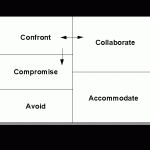
There are two practical ways to not engage (accommodate or avoid) and three others to engage, as shown below.

Strategies for Resolving Differences: 

Strategy and Theme

Avoid — “Leave well enough alone”

Accommodate — “Kill ‘em with kindness”

Confront — “Might makes right”

Collaborate — “Two heads are better than one”

Compromise — “Split the difference”

Using the earlier example of a verbal sharp stick, you can use avoidance to disengage, as in “I’m not available for this conversation right now.” Or you could constructively accommodate by refocusing only on what they’re wanting for the future with “And what do you suggest we do differently next time?”Most of us rely on one or two of the five and would benefit from practicing use of the others. What are the situations when each is the right choice?

When Not to Engage

Avoiding is appropriate when there’s no way to win or there needs to be a cooling off period.

Accommodating involves listening and accepting without resistance, effective when the issue is less important than the relationship. Accommodation on minor issues which are important to others are gestures of goodwill and are a way to make deposits in someone’s “emotional bank account.”

Not engaging is different than resisting or being defensive. It can be a conscious, deliberate choice to not struggle, to protect the relationship, or to stop adversarial, win-lose dynamics. Rather than “meeting them at their own game,” call the game over and arrange to play another day in some other way.

When to Engage

On the other hand, do you sometimes have trouble taking a firm stand, even when you see the need? That could a sign that you rely too heavily on avoiding or accommodating.

Gently confronting the other person and assert your view might sound like “I didn’t use your idea because … and how can we work it out so that you can contribute here and I still get to decide how to do my job?,” which leads to collaborating on a solution. If you find yourself often hurting other people’s feelings or stirring up hostilities, consider using the other four strategies.

Collaborating might involve working together to generate win-win alternatives to resolving the issue. If you rely too heavily on this one, you’ll spend time discussing issues in depth that do not seem to deserve it.

Compromise, used to get to quick resolution, involves bargaining and mutually giving up something to reach settlement. “If I use your idea will you stop bugging me about it?” It doesn’t really solve the core issue, but it does quickly handle part of the problem and prevents further escalation.

When you know people, and you know yourself, you’ll be able to quickly assess if you can “get there from here.” To find that balance point where boundaries are neither too rigid nor too fluid, consider varying your approach by practicing each strategy for 3-6 weeks, then they’ll be available when you need them most.

When to Negotiate Directly

Lastly, negotiation makes sense whenever you can make the other person an offer or proposal that they would find more attractive than their next-best alternative. In addition….

  • When it’s up to you, when there are no better alternatives
  • When the task or issue is important (if it’s not, either let it go or lead strongly)
  • When you’re not so fully invested in a position that you can explore options
  • When not negotiating would cost you; when you have something to gain
  • When there’s been a misunderstanding; when there is no understanding or agreement
  • When you’d like the satisfaction, peace of mind … from handling differences openly
  • To be a model: to demonstrate what effective negotiation looks/sounds/smells/feels like.

The Art and Practice of Agreement

By Daniel Robin

This article takes a deeper look at how having clear and complete agreements often spells out the difference between success and suffering.

How in the world can we build a workplace based on well-considered agreements when …

Co-workers, employees, and customers quickly knee-jerk into “Yes” or “No” responses — before they even know what’s being asked!

Everybody, including you and I, already has way too much going on.

Some people’s “yes” doesn’t mean much (they break their promises hoping nobody will notice), and if you call them on it, they get immediately defensive.

The Practice of Making Agreements Stick

In our culture, requests are quite often indirect. “I was hoping you could think about the possibility of maybe someday considering …” I’ve found that if I just ask “What is your request?” we both save lots of time and energy. Most people will appreciate increased directness with the “what” — the goal or reason for asking — when you demonstrate a willingness to be flexible in “how” it will be accomplished.

How do you now make requests? Think about a request you recently made and jot it down verbatim, noticing which of these elements were actually present:

Five Element of a Complete Request

(1) Who is doing the asking,

(2) Listener who is being asked,

(3) Action — what’s the desired future result?

(4) Conditions of Satisfaction — how will you know if it has been done properly?

(5) Timing — by when?

All five elements must be understood by the listener, or you may well be asking for … trouble. When it matters, I double-check with “Will you tell me your understanding; I want to make sure I explained it right.”

Responses To Requests

The requestor checks for one of four specific responses, listed below, and doesn’t accept ambiguous responses like “I’ll try”, “Maybe … I’ll think about it.” or “I guess I could do that.” Instead, a response is either a

Promise — A statement that says, in essence, “Yes, I will do that.”

Decline — “No, that doesn’t work for me.” Also means “Count on me NOT to do that… ”

Counteroffer — “No, I won’t do that, but here’s what I will do…” which opens up a negotiation.

Commit to commit — Meaning “I don’t know yet, but I’ll get back to you by noon Tuesday.”

Note that commit to commit must include the “by when” or you really don’t have a commitment to anything. If they don’t know when they’ll know, ask for a counteroffer, ask what they need to decide, or ask someone else.

If they say “yes” ignoring their concerns and resistance (or worse, if you ignore it), that will prevent you from being able to fine-tune your request, or keep you from asking the right person. Draw out concerns, what’s at risk, potential obstacles … then get a clear commitment one way or the other. Each response forwards the action in some way, and looking for one (and only one) of these will clear up ambiguity and prevent assumptions.

Taking the Pulse: Renegotiation

How often do you say and do the same thing? How do you currently handle it when you’re not able to keep an agreement?

If we’re suffering from having said “yes” to too much (or “no” to too little), we’d be wise to renegotiate the agreements that are currently causing the overload.

When a reasonable agreement is already in place and difficulty arises, imagine how much misery could be prevented if the promise were renegotiated in a timely way, while there is still time (hopefully) to do something about it.

Build it to Last

If we take time up front to carefully consider responses to requests it saves tremendous time and trouble later. With practice, we can learn to make clearer, more complete requests of others, and verify their understanding, thereby building commitments that last.

People will probably squirm like crazy when you start making more direct requests. That’s okay; you might mention that you’re trying something new and would like them to experiment with it. Sometimes discomfort is a necessary step toward better results and relationships.

Organizational Pathways: Part 1

Waging Peace in the Workplace

By Daniel Robin

With the increase in work force diversity, emphasis on teams, and the new-world-disorder — also known as chaos — sooner or later, we all get into conflicts that just don’t resolve, even with a Ph.D. in active listening mode. Calmly sitting down to “talk about it” can be frustrating when there are hidden agendas, turf wars, or fear patterns in the culture and in the people involved.

So what if you give it your best shot and nothing comes of it? A willingness to deal with an issue — even if the effort is clumsy at first — is far better than the insidious patterns of avoidance, denial, passive-aggressive indirectness, plotting how to get even….

In the gap between theory (what we know) and practice (what we do) lives an astounding fact: our culture has developed remarkable tools and technologies for handling virtually any type of dispute; however, the ones that work are seldom used, and the ones that are used seldom work.

Finding Alternatives

I’m surprised how few people have even heard of “alternative dispute resolution” (ADR). Here’s a quick quiz:

What is arbitration and when would you use it?

Under what circumstances should you use a “third-party neutral” (hint: before you begin to unravel emotionally) and

When is it best to handle a situation yourself?

What does mediation have in common with arbitration? What are the differences?

If you know the answers to these questions, you probably practice ADR for a living. Unfortunately, our schools are only just now providing this practical information – so vital to success in today’s workplace.

It is simply not true that the only way to deal with conflict is to provoke more of it. Even in the most difficult situations, the other person isn’t necessarily our adversary. Our congested court system is hardly a place to bring important, emotionally-charged issues — business-related or not. And yet, despite the uncertainty that goes along with giving up control, power and major dollars to someone else to work out a legal “remedy” (notice it’s not called a solution), we still rank as the most sue-happy culture in the world.

How ADR Applies to the Workplace

What makes the workplace unique and challenging is that most relationships can be strengthened through collaboration, and yet, few people seize this opportunity. Perhaps it’s just too darn risky and uncomfortable to surf the chaos of including other views and perspectives before deciding what to do with them. It certainly seems faster and easier to reduce options to a tidy twosome (“my way or … “), then you can pick the least lousy alternative. The phrase “What are some other options?” can work wonders.

It takes careful and confident facilitation — and sometimes it takes not being in the middle of the issue — to broaden the focus just enough to generate and explore options without getting derailed. The facilitator needs the flexibility to move with the other person or group, the focus to keep working toward goals, and the smoothness not to interfere with communication in the process.

California is ripe with caring professionals who would like nothing better than to have everyone live in peace and harmony. And yet [Excuse me while I yell at my cat. Now, where was I?], we cannot drift too far from getting business results, or we’ll have no workplace to be peaceful in.

Above all, workplaces need to be fun. Wage peace and we’ll enjoy the dividends of a wage increase with profit for all.