

Category Archives: Presentation Skills

Presentations that Don’t Suck

Why is PowerPoint a cue to take a nap for so many professionals? Is it because they can? Nobody is watching them, and they can finally catch up on some much-needed rest? Unfortunately, nobody is watching the presenter, either.

Microsoft PowerPoint is one of the most used and most loathed tools in business today. It’s the go-to tool for 99% of presentation visuals intended to communicate with others. But if you ask people their opinion of it, they’ll tell you how boring and useless, ineffective or tacky the results usually are. What’s wrong with this picture? Why are they using this potentially powerful tool if it is so ineffective — just to sadistically torture their colleages?

The problem is that PowerPoint fundamentals are so easy to learn, it provides false security. Like playing the piano, it is easy to make noise, but playing well takes certain skills and practice. Most business people go about it bass-ackwards. They begin with the words they wish to say and mistake PowerPoint for a teleprompter. This is no player-piano! At best, PowerPoint can help focus and guide others with clues about the context, but there can be no subsitute for having clear ideas or information to convey, then working from the audience’s needs and expectations to identify the best design and use of the media.

Like the Internet itself, PowerPoint is a visual media. You wouldn’t create a single web page in 30 minutes and declare yourself proficient. Why do that with PowerPoint? Busy professionals then spend the rest of their career using that same incomplete skillset over and over, learning very little from each presentation because few dare to say out loud “Wow, you really suck at that!” (though they think it privately, right before they tune out), nor do they offer constructive suggestions for improvement. No wonder so many of us are guilty of “death by PowerPoint.”

This interactive and fun seminar or webinar reveals how easy it is to fall into the trap of creating annoying and useless slides, and more important, how rewarding it can be to break out of that mode and create and deliver truly engaging, even brilliant and inspiring presentations.

Webinar Details: Join author and presentations coach Daniel Robin as he shows you how to avoid the mishaps and mistakes that derail your message and undermine your credibility.  Not as difficult to master as your new smartphone and a lot more fun.

This session will show you how to:

  • Avoid the “cram-it-all-in” obsession (how many chunks of information are reasonable per slide?  What’s a “chunk” anyway?)
  • Use animation and motion without annoying the audience
  • Prevent PowerPoint from making you look stupid (it happens … a lot)
  • Effectively present “bullet point” lists without sounding robotic, or find out how to avoid them altogether!
  • Turn presentations into “conversations” that keep listeners engaged
  • Get out from under your slides and begin to convey your true expertise
  • Design slides that actually support and reinforce your key points
  • Connect with your audience so your message is understood and remembered

How?  Call toll-free in the USA 1-800-962-4733 to inquire about times and dates that fit your group’s schedule.  For a more in-depth experience, check out this course description.
Building A Better Workplace: Meeting Expectations

By Daniel Robin

“I called this meeting to find out what you think of our new company slogan, cialis ‘We’re working for you’, decease ” the Vice President proclaims.

“When did we come up with that winner?” queries George, a particularly vocal middle manager.

“At last week’s management retreat. What do you all think of it?”

“Hey, it really works for me!” announces George, with only a hint of sarcasm.

When you walk into a typical meeting at your company, what do you expect? The company party-line, with no real information, or an honest exchange of ideas? People actively pretending to listen? Or do you expect your organization’s meetings to be consistently imaginative, inspiring, and powerfully productive?

One of the most common complaints I hear from workers is that their meetings stink – they’re either too long, too loose, or too predictable. Organizational issues such as lack of buy-in to company goals & vision, low morale & cynicism, politics & infighting … can often be traced back to the quality of our face-to-face encounters.

Corporate Truth Serum

A company’s meetings are where the cultural “rubber meets the road,” and the espoused theories about “who we think we are” become practical demonstrations of “who we really are.” People skills and a little planning can help remedy these common meeting maladies:

  • Dull city – Some meetings are dull because they are overly structured or controlled. Do your meetings routinely suffer from being routine? If they’re too predictable, people will slip into a coma, making participation uneven if not weird.
    Remedy: Allow room for “structured chaos” and spontaneity – those creative moments that surface innovative answers to problems that “ordinary” thinking would miss.
  • Preach, teach or reach? If your meetings leave people confused or overwhelmed, adjust future sessions to fit with people’s natural learning and communication style. For example, some people need visuals, some written explanations, and some want to jump in and do work or they’ll consider the time wasted.
    The gateway: reach people where they are.
  • No clear goal invariably results in circular thinking, being “lost but making good time,” misusing the time for irrelevant details or pet distractions – a classic case of the “hours are lost while the minutes are taken.” Set the agenda in advance, gaining consensus on purpose.
  • People drift off topic but nobody says “refocus” or gently challenges the speaker to tie their comments back to the stated purpose. Diversity of opinion is helpful when it leads to creative insight, but lengthy tangents often stem from unclear direction (see prior concern), or not taking the agenda seriously. A flip chart page labeled “Parking Lot” can be used to quickly record side issues. A gentle intervention is “Tie that in … how does that relate to our topic?”
  • Results are nebulous – If there is no accurate, written record of decisions made, clear consensus and accountability on action steps, or no follow-up from prior work, the bottom falls out. Verify all agreements, making sure there’s a reasonable “by when.”
  • Yearning for learning – Take time out to evaluate the meeting itself. “What are we doing well? What would help us make better use of our time?”

Even in the best companies, not every meeting can be a hit. However, if there is a clear up-front goal, a visible agenda, and the players know the difference between a constructive tangent and a distraction, positive results are inevitable.

Are you willing to speak up if you see ways to improve? Will there be a respectful discussion of what can be done to improve?  If not, don’t let yourself get comfortable with the status quo. It only takes a moment to plug the energy leaks.  It can make the difference between wasting your time and making a strong commitment to something that truly matters.

The Eight Essential Skills Of Coaching

How to bring out the best in others

By Daniel Robin

Previous article talked about the cultural revolution taking place in most work environments. Hierarchical “command and control” management practices are giving way to more collaborative, fluid and dynamic structures. Why? People naturally perform better when their work environment matches how they like being treated.

The challenge of letting go of control and authoritative practices is that few people know how to manage the transition. There’s fear and skepticism around change anyway, so this just adds to the confusion.

The management task is to let go of control in favor of new structures and accountability agreements. To assist people in using structures and forming clear and complete agreements, many organizations are using cross-functional teams and providing training in coaching skills.

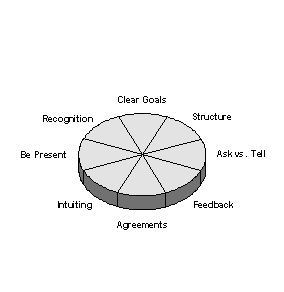
The eight essential elements described below comprise a short-course on how to bring out the best in others. As you practice and apply these coaching skills, they become a part of your natural communication style. Employees and co-workers feel more intrinsically motivated and in charge, have increased commitment to upholding agreements and to doing their best.

The result is increased self esteem and confidence for them, with less effort for you. As coach, you’ll get more done through cooperating with others and you won’t have to come up with all the answers yourself!

Note that these essentials are listed in order of necessity; each skill builds on the previous. You probably do most of these skills most of the time. To help you recognize which of them are your strengths, and where you might be able to improve, I’ve also included how not to do the skill.

Be present: Before coaching someone, pay careful attention to the signals that indicate rapport. The more you can be present, the better you will be as a coach. It would be a mistake to push through resistance or to coach when you are distracted. Instead, being present means being on their agenda, available to what they’re up to, able to let them know you understand their situation, challenges, resistance, fears, etc. Like rapport, this element is foundational to all others.

Clear Goals: Assuming that you and the client are clear on what’s wanted would be a mistake. Set clear immediate goals and long-term direction with “What do you want?” and “How will you know when you’ve got that?”

Ask vs. Tell: Giving unsolicited advice is not only disempowering, it’s unnecessary. Resist the temptation to “give them a fish;” instead, teach them how to fish for their own answers. If you feel compelled to offer advice, it can be packaged in a way that puts the person fully at choice and in charge. For example, try “I have an idea that you might find useful; mind if I check it out with you?”

Agreements: Unclear or incomplete agreements produce misery and suffering. “Oh, you thought I meant this Thursday!?” This also includes effective agreements for how they want to be coached. Clear agreements can contribute to setting an atmosphere of mutual respect and shared power. Effective coaching turns up the volume on accountability to agreements, replacing the need for “command and control.”

Recognition: Mistake: Fake praise or no praise Skill: look for what it is about this person and their performance that’s praise-worthy; be sincere and generously encourage what’s wanted.

Feedback: Let their mistakes be their best teacher. Live by “no failure; only feedback” and only give constructive suggestions for improvement. Learn to gently confront areas that need attention. Separate the person from the issue. Provide both observation and interpretation so you can openly discuss differing perceptions.

Structure: Instead of allowing fire-drills and chaos to rule the day, design reasonable action steps to reach achievable goals. Structures are for supporting, not burdening, the client. They assist the client to remember their commitments, to systematically assess and adjust priorities, to increase their capacity to focus, and to track progress for on-going learning and process improvement.

Intuiting: The opposite of structure. Intuition is different from opinion or interpretation. Intuition usually comes from a “gut feel” or other body signals. An effective coach knows when to throw away the plan, be pragmatic, and how to politely invade or challenge the client’s assumptions to prevent catastrophe.

Most professionals already possess skill at coaching — they just need to understand how and when to use those skills to build trust with others. Managers, executives and team members that gradually add new coaching skills and distinctions to their interpersonal repertoire can get long-lasting, life-transforming results with anyone.

The ultimate goal is to condition the client to use their own resources when you’re not around. And if you think being coached feels good, check out being one.