

Category Archives: Trust

Trusted lies and the meaning of money

Recent reporting in the US indicates that we have accepted, as a culture, a “new normal” of half-truths and blatant disregard for facts.  Seriously?  Yes, unfortunately, this is no lie.  I wish I were kidding.  Apparently, some will consider this is a virtue, a victory over the rule of law, reason, and unadulterated honest dealings. It isn’t.

Repeated lying, especially the “rinse, wash and reTweet” kind, eventually has its comeuppance.  Drawing back the curtain of truth to reveal a squishy, truthy, ambiguous and slightly “magical” land, a universe where you can tell anyone that facts are for people too weak to imagine being a stronger, more confident leader?  This has gone too far.  The “Emperor’s New Clothes” may fit to a tee, but that’s still the ugliest suit I have ever seen!

But how do you reckon with “charming” liars who tell you what you want to hear, even (especially) if it doesn’t happen to be true? Humans are believed to have a predisposition to “situational” lying. The situation did it to me, make me do it, thus I cannot be held accountable.  Who makes up this stuff?  Apparently, some of us do, on a regular basis.

Being one’s word has to be more than how we feel in the moment.  Sure, we all have occasional lapses, but true strength comes from having the integrity to clean up a misdirection before it turns into a mess.

Speaking of messes, there is tremendous social pressure to “believe” what others tell you, if you wish to be accepted.  The need to belong or “affiliate” sometimes overrides the more rational and ethical part of the brain.  It is a powerful opiate.  This may be explain why there are those who buy into wild conspiracy theories that the rest of us know are not true, or at least such shared beliefs are so implausible (take QAnon for example) that there’s little reason to even check sources. Or how about whether or not Coronavirus was invented in a lab?  I guess you’d have to ask the lab managers.

We say an idea is a conspiracy theory when we want to completely discount it and to discredit its speaker.  People on both sides of the current US political polarization fall prey to a long list of bat-shit-crazy views, mostly a form of “group think” that is reckless, dangerous and often just sad.

Do we need to start a massive re-education program on critical thinking, the rule of law, and how science and other evidence-based practices can help quell the disinformation channel?  Unfortunately, no such luck.  It wouldn’t help because there are unexpected benefits of buying into conspiracy theories that seem to outweigh the risk of reputation loss or to being seen as mentally disturbed.  Those who entertain and ultimately buy into such theories are now part of our culture, too, pushing rights to free speech to a place that has only recently begun self-correcting.

Further, the tone of discourse on this topic tends to be highly combative, no doubt out of righteous anger and frustration with those who follow those pesky little things called facts, or those (some would say) that think for themselves, not as the media wants them to think.  That seems to include both those who lack imagination — and need to assume things are not as they appear — as well as those who apparently have too much of it.

“Coming together is a beginning.
Keeping together is progress.
Working together [skillfully] is success.”
                                               – Henry Ford

For my part, I can no longer gaze upon this world gone mad, where science is just an “alternative” set of facts to the “truth” that others see, and expect it to end well.  Even during times of crisis, observing more than one set of facts with dispassion is like some rubber-necking motorist witnessing a slow-motion train wreck.  The moral detritus is piling up, and the highways and byways of truth are clogged, choking and sputtering on the accumulating BS, even as the economy (once called the “global casino” by Fritjof Capra, now the title of a titular book on human-caused environmental issues), immune to what people think, has begun to find its “true calling” or higher purpose in several opportunities that deserve our full and unequivocal support. Money doesn’t care.  So we have to.

Since this column is about business, I’ll now navigate away from politics to discuss the more important realm of money and meaning, supposedly the reason many of us choose to work in the first place.  The political overlay is about context and how we treat each other.

Money & Meaning — what’s the cost/benefit of making a buck?

The purpose of money is not merely to perpetuate itself to make more of it.  To many of us, making money is, by itself, devoid of meaning, so we must ascribe to it that which we find meaningful.  We make it up.  What has meaning for you?  What matters most?  Second most?  I often suggest that any journey include at least three ways of measuring success.  This will usually (if done right) reflect cherished values and principles.

If our values allow us to pursue wealth and luxury for its own sake, just to have wealth, or to be wealthy, no matter the means, then that outdated view of capitalism explains the unruly game that gets played in many circles.  But what of human relations?  Do we wish to stay inside this circle and only trade with those who will uphold a money-focused “ethics free zone,” or would we prefer to find richness, beauty and fulfillment in a wider circle, one that which includes those that may sharply differ from our own worldviews, but are nonetheless interested in mutual respect, dignity, and wholesomeness?

I guess the question reveals my bias … yes, there is a right answer, but maybe it is not so simple.

Now I’d like to use the current US “political theater” to highlight a few salient points.  The clogging arteries of “truth and justice” do not end well for anybody, so we are starting to see an expose’ on “the game,” from both a linguistic and humanistic perspective.  I’ll add my two cents to the mounting literature, some of it pleading, occasionally moralizing (if there is a choice of taking the “higher road” to a flourishing life, wouldn’t you take it?), because in my view, we simply cannot continue like this, socially distant, for now, but worlds apart.  Enough is enough.

Is changing one’s mind a sign of strength or weakness?  Yes.  I mean, No.

A huge insult in politics is to call someone a “flip-flopper” and yet changing positions (based more on new information, or dawning awareness, not just political convenience) has become part and parcel of rewriting history, an attempt to “reframe” reality, to bend it, as some sort of a revisionist’s dream, stating and restating the world as we wished it were.  As if the current position is the only one that matters and nothing that has come before matters?  Admittedly, the American public has a short memory span, made even shorter by Twitter and other top-of-the-trees reports and voices that would like to matter.  But to neglect recent history in favor of the one preferred by a determined group is just another deception that must be rejected.

Remember the saying, “If we knew better, we’d do better?”  Guess what?  We know better.

I once had a mediation gig in Kuwait.  It was a very entrenched dispute that had gone completely off the rails.  Every day, for nearly 3 weeks, the parties agreed to put their differences aside and declared a new day.  This was inefficient, at best (although at that point it was the all they could do to show a willingness to restart talks without losing face).  Later we did manage to talk about the past and learn from it, and go on to finish the project, but even with strained relations, business leaders must reject the tendency to cast aside all prior results and plans in favor of a “new day.”  The enterprise’s history and team’s core values must inform decisions starting today.  What’s the hype versus what’s the hope for a shared future?  That’s a conversation worth having!

Lying certainly can have an upside (some claim that such manipulation is good for your career), buffer our relationships, provide excuses for someone to temporarily feel safe with their own truth. We often lie to ourselves, and who hasn’t tried to get away with a so-called white lie here and there? That doesn’t necessarily make you a liar or a bad person. Not knowing how people lie and twist the truth could set you up for being blinded when someone else does it, but that isn’t an endorsement of crime as a way to catch criminals either.  Learn how to handle your own fluctuating emotions and need for ego gratification without taking others prisoner. This is what responsible adults do.

Energy Conservation Starts at Home

The corporate mindset of the media made a big deal about Bill Clinton’s affair(s) because they could.  We see this ‘smear job’ (tongue in cheek) of attack-and-defend tying up a huge amount of energy in the political sandbox — nothing more than drama born of win-lose thinking — energy that could instead be used for getting on with the real work of improving the sandbox.

What is presently just a distraction begging for you to take the bait (yet again), the monkey chatter in the leaves of the tree (Twitter still has a lot of it, as does all social media, even if they’re recently growing something akin to a backbone) versus the more important question, “what about the trunk?” What do we wish to grow?  How will we grow?

The Wizard of Oz invited us to not be distracted by the man behind the curtain.  Why do such illusions often seem so real, and why do we keep falling into the trap of getting hooked by the drama of opposition or of adversarial alliances?  It is one of the oldest distraction techniques on earth.  Sun Tzu‘s “Art of War” was published before any of us were even born, and yet it continues to play on our humanity, our vulnerability, our darker tendencies?  Its called shadow.  We all have one.

How to rise out of that conundrum and into the light?  Be sure not to get caught up in fear.  The antidote to fear, a similar experience in the body, is excitement and audacious assertiveness (“a willingness to take surprisingly bold risks”), but doing so skillfully and respectfully. Why?  Because we can’t easily minimize or eliminate fear, thus better to maximize our audacity … with integrity, honesty, and skillful presentation to the right people, asking until … [we reach our goals], acting as if we have nothing to lose (because we don’t, in that context), building confidence in our better offer, building character, and honing our core selves.

Even if democracy takes a serious body slam among the way, at least we’ll be better humans, worn smoother around the edges by the friction caused by our respectful audaciousness.

I’m writing all this in hopes of ensuring that this situation, longer-term, doesn’t drift into an unrecoverable lose-lose dynamic for all us stakeholders.  Short of believing in miracles, we seem to be heading down the road of fewer options than normal.  A 2-party system is becoming a no-party system. Narrowing our choices because we’re uninterested in booting and using the part of the brain that involves reason, reflection, or funny little things called facts must not become our de facto plan.  That’s worse than having no plan.

3M’s — Manipulation, Misleading, and Masquerading

A recent transaction with someone in West Africa supported the value of American politics admitting that they liked the “all action, no talk” approach.  That is hardly what we want to teach others, and behavior role models are what we Americans (and others in the developed world) offer, by silent default, unless refuted, or cast out.  I cannot condone such mindless and corrupt reasoning, so let’s talk about these three M’s and then define the higher road.

M1:  Manipulation:  “I know you are but what am I?” is the childish ploy of turning the table on the schoolyard, employed regularly by master manipulators.  Point-by-point comebacks that set the record straight are rare but necessary.  This is the art of war and getting one’s message across.  “Crooked Hillary” and Lying Ted Cruz are examples of manipulation in the last election that became memes (spread on their own) cannot displace facts to the contrary.

M2: Misleading information about elections being hacked or corrupt just don’t line up with the facts.  Spreading an effective lie (so that it travels well enough to “infect” millions of others, as thought-viruses often do) is still lying.  Our ability to survive and thrive as a nation depends on regaining our sense of what is real.  It may take a long time to get over this past “race to the bottom” with so-called fake news, hyper-partisanship, and polarized “enemy stance” … mutually assured destruction, but it must be carried in the minds and hearts of every American, even as the “tribal warfare” unfolds.  Things have gotten far too bad and it is far too late for cynicism.

The US has been in the de facto leader on many fronts (though lagging behind in some areas, such as protecting the environment) for decades.  More recently, we began “exporting” an unfortunate byproduct of our bipartisan politics:  the belief that action is more important than truth.  That if you act strong and appear to be decisive (even if resultant policy decisions are entirely wrong-headed) somehow that is more important than the nuance and care required to live according to one’s principles?

If greed is all that matters, and the end justifies the means, then take everything, leave nothing but a trail of betrayal and scorched earth, and be sure to never apologize, admit one’s mistakes, or learn anything.  That sort of self-reflection is for the weak.  What kind of leadership is this, exactly?

M3:  Masquerading:  Instead of masquerading for effect, or playing the role seemingly required of us by party, church, the boss, spouses, etc., how about if we show up as our authentic selves?  I know this sounds simplistic, even somewhat outrageous to suggest, but as written above, and in a business plan recently, “Audacity has to outpace fear.”

Stand up, Put people in their place, Set boundaries

The race to the bottom has finally arrived.  We made it!  So now what?  Instead of planning another attack on democracy, or on each other, what we can and must do is uphold our respective areas of mutual respect, set the tone, but don’t be “nice” about it, be real.

The meek may yet inherit the earth, but will they want it?  And would they have the nerve to step up to the podium and accept it?

Thanks for listening/reading.  Respectful rebuttals are encouraged.

Daniel
Trust: Part 3

Trust This: Five Ways to Be Reliable

By Daniel Robin

The last two parts of this article reframed “trust” as “being able to predict the other person’s behavior,” describing some of the dynamics that help you minimize the risks of counting on others. Like most facets of interpersonal relations, on this important two-way street called “trust-based relationships,” you’ll get where you want to go if you focus primarily on your own driving. If the other guy or gal is swerving and acting crazy, skillfully get out of the way.

In other words, if you want trust, focus on how to be trustworthy.

They Call Me … Mr. Responsible

How is your own conduct? Are you consistent, and reasonably predictable? Or do you do different things at different times? Some people are what I call “random behavior generators” — they’re so intent on being hard to peg, without explanation, they’ll rearrange their furniture, change their hairstyle, or shift an opinion mid-sentence, just to hear people say “How interesting….” Certainly, some mystery is good (or at least entertaining), and you’ll get a better response from people if they understand your motives, intentions and goals.

How do you know if you’re seen as trustworthy? Ask yourself this fifty-cent question: “To what extent is there alignment between my core values and behavior, my intentions and actions, my communication and the response I get?” Your mission, should you choose to accept it: systematically close the gap.

Agreements as Safety Net

Have you experienced times when you felt out of control at work? Nothing went as planned (planning? what’s that?). Agreements also serve as an objective standard for gathering feedback when “life happens” but the agreement doesn’t. Here are five tips to reliably improve your reliability:

Tip #1: Make fewer and better agreements, and trust will soar

Making fewer and better agreements will help you honor the ones you do make, and deal more effectively with situations outside your control.

This tip isn’t suggesting that you intentionally overcommit but rather that you’d damage your credibility if you allowed others to hear a “yes” when you didn’t fully mean it. If this happens, who is responsible for their “hallucination?” They probably are. But handling possible misinterpretations on the front end is much easier than damage control.

Tip #2: Learn to learn

It’s more important to be consistent than to be perfect. Nobody I know, even those with the highest of integrity, can honor all their agreements all the time. That would require either perfect self-knowledge or living in a vacuum. So when things go their own way, focus on learning how to do it better the next time. Act as if there’s no such thing as failure, there’s only feedback.

It takes practice to take the appropriate amount of responsibility in a dynamic situation, to respond to criticism non-defensively. Listen for their intended meaning (ask “Do you mean…”) and accept their opinion as information you’ll seriously consider. Follow up with them if you decide to apply something they’ve said.

Tip #3: Renegotiate as early as possible

When a promise must be renegotiated, do so early, anticipate and the focus will be on the agreement and what can be done, not on your reliability, limitations, or whose fault it is.

Tip #4: Renegotiate any dysfunctional agreements

If you continually rely on someone that does not produce the goods, you suffer. Do you know anybody in your life who is, in a sense, wearing a hole in your pocket? You stretch to give them another chance, time and time again. Some relationships, by contrast, pay dividends, while with others, you could say that your “trust fund” is overdrawn. Over-reliance can be balanced with a good dose of appropriate skepticism and a tighter, renegotiated agreement. A negotiated agreement will help shift the burden of responsibility so that there’s two of you trusting.

Tip #5: Say what you mean (and mean what you say)

Being direct and tactful in equal measures helps others feel safe. If you’ve got some difficult feedback to deliver, balance your message with positive reinforcement, say how you feel about it, and encourage them to do the same. Your courageous and considerate communication will send a signal that you can be trusted, even if your message isn’t good news.

As others see you being open and forthcoming, they’ll quickly clear up any misunderstandings, be straight and direct, and expect the same. When trust is based on being able to predict the other person’s behavior, you’ll have a reason to be curious about how people operate so you can discover and play to their strengths.

Trust: Part 2

Where Does Trust Come From?

By Daniel Robin

Trust, like respect, is earned. Think of it as an investment. You observe a person’s behavior over time, and gradually decide whether or not to invest your trust in them. Though everyone initially deserves a base “line of credit,” it would be unwise to rely on “just anybody” in high-risk situations.

You wouldn’t ask someone with no computer skills to create a spreadsheet of the company’s financial status (bite-sized projects and lots of quality mistakes come first). Likewise, it would be unfortunate to not trust someone who deserves it. If I’m risk-aversive, I might not see how competent and trustworthy you are. If I’m unable to let go, I’ll never know. Not taking risks can be just as risky.

We’ve previously defined trust as being able to predict the other person’s behavior. Consistency and reliability can be observed and measured; the idea of “trust” cannot — it’s subjective. Learn how people operate — where are they most predictable, where are they consistently able to get the desired result? — to form a risk-neutral basis for collaboration.

But people, like the weather, aren’t always predictable. And risks will remain — risks of misunderstanding, changed circumstances, and unforeseen events. We must balance focus on the task with building a valued relationship, courage in moving toward our goals with the consideration to involve and include others, healthy skepticism and downside planning with well-founded trust. Somewhere between total confidence and deep suspicion and fear.

Play to their Strengths

If you want a practical basis for leading your relationships toward greater trust and collaboration, form agreements that bring out people’s unique combination of strengths. Having clear goals isn’t enough; you want buy-in and commitment up front to serve as the structure for accountability, feedback, and continuous improvement.

As you pinpoint and play to strengths, weaknesses become irrelevant. If a perceived weakness (or what I prefer to call a “strength in training”) has you questioning their trustworthiness, set up an agreement that directly handles your concern. If the person grumbles at your apparent lack of trust, ask “How can we work this out so that … [you get credit for successful project completion … and I get to relax knowing you’ve handled it well]?” Agreements serve as a safety net for playing the medium- to high-risk game of business, and with contingency planning, can serve both parties in case things go wrong.

Though it may bring up genuine concerns to give a new priority project to someone who is undermotivated or as yet “unproven,” that might be exactly the reason to do so. The practice of stewardship delegation establishes clear guidelines, and through a negotiated agreement, sets people up for success. This prevents micro-managing and empowers people with authority, not just responsibility.

Feel the Fear and Lasso It Anyway?

Concerns are low-grade fears. Fear exists for a reason; it intends to protect from harm. A sign that you are still sane, fear represents something you don’t want — a negative consequence that’s worth avoiding or preventing. Sometimes a fear needs to be surfaced and addressed — unearth the consequence you want to avoid, assess the actual risk vs. potential reward, and do something to mitigate that risk. At other times, it’s best to just acknowledge a concern and let it be — such as, when there’s anxiety, confusion, vague uncertainty or doubt, but not much chance that things will go really wrong. You can ask yourself “What’s the worst thing that could happen?” and then formulate a plan to safely avoid that consequence.

Fear is a motivational strategy, and recognizing that it is present increases its usefulness. Note, however, that there’s a big difference between carefully avoiding an outcome you don’t want (like death, embarrassment, or being audited by the IRS — all worthy of taking preventative measures) and simply being afraid. It’s not much fun to be “in” (enveloped by) fear, so notice it and perhaps say to yourself “fear is present,” so you can lasso it.

When it comes to building relationships based on trust, a certain amount of discomfort or “edge” is probably a good sign. Stretching away from your comfort zone is the antidote to complacency. In the end, getting past your fear is less frightening than passively enduring it. As Will Rogers said, “Even if you’re on the right track, you’ll get run over if you just sit there.”

By the way, an anti-fear trick learned from the animal kingdom: breathe deeply….

Tips for Becoming More Reliable

If you want others to consider you trustworthy, focus on your own reliability. This is the topic for the next article. Really. I promise.

Trust: Part 1

What’s Trust Got To Do With It?

By Daniel Robin

Practically everything! Have you ever heard someone say “I just can’t trust that person!” or “Hey, why don’t you just trust me?” Trust is an odd thing: on the one hand, it’s probably the single most important ingredient in successful relationships. On the other hand, partly because trust is in our heads — a state of mind, an interpretation, a subjective feeling that develops over time — it is not clear how to reliably improve it.

Of the importance of trust there is little doubt. A high degree of trust would permit me to take you on your word, to accept your statements at face value without question. I could give you the “benefit of the doubt.” We’d be free to derive maximum benefit from our relationship.

On the other extreme, a high degree of distrust creates quite a mess: a climate of fear and anxiety would make productive work nearly impossible, shifting the focus from flowing collaboration to suspicious second-guessing, guarded (if any) participation, and probably a pattern of conflict avoidance or passive-aggressiveness. Worse, our moral judgments about each other’s untrustworthiness make resolution of these problems quite unlikely.

Most workplace relationships fall somewhere between these two extremes. What’s wanted is not just blind trust, but a solid confidence grounded in reality. The challenge: different people give different weight to the importance of being reliable, of keeping a promise. The key: accurately give the degree of trust that is (1) appropriate for that relationship, and (2) necessary for obtaining the results you’re after.

This article and the next two redefine trust in terms that you can discuss openly with others, will help you to strategically increase your ability to trust others (while handling potential risks and downsides), and will explore how you can become more trustworthy.

Trust, a Second-hand Emotion?

In our culture, there’s a tendency to think of trust in terms of the other person’s trustworthiness. And yet, the one person over whom you have a reasonable amount of control is — you guessed it — yourself. Thus, if you focus on whether or not you can trust others, you’re just as likely, one of these days, to experience distrust as not. Sooner or later you’ll come up with an example of how they “just can’t be trusted.” A more useful question to ask yourself is “Can I predict their behavior?”

Consistency isn’t simply a virtue, it is a practical basis for developing effective working relationships. If you can predict someone’s behavior — even if you know they will screw up — you can count on that. This means that the goal is to learn how people operate: pay attention, notice what results they consistently produce and where they get stuck, so you can handle contingencies, mitigate the risks, or involve someone else.

For example, when considering delegating a project, ask yourself “Will this relationship support these results?” If not, why not? Relationship too new? Results too important to fully delegate and let go? It probably wouldn’t work to say “I’d like to trust you here, but ….” So what can you do? Talk openly about your concerns, your desire to let them run with it coupled with your conditions of satisfaction.

As human behavior is normally difficult to predict, use your interpersonal skills to form clear, unambiguous agreements and use those agreements as the proving ground for reliability. By setting expectations (“conditions of satisfaction”) on the front end, and make sure you get a clear commitment, yes or no, on or off. That helps us hold accountable based on facts and evidence, not just based on our personal history.

Trust Isn’t the Goal, It’s the Result

If we give up trust as a goal, our past negative experiences when we trusted unwisely will no longer color our interpretations. You’ll have a living demonstration of a person’s reliability (and they’ll have one of yours), so you can both trust the truth — and learn from it.

The Eight Essential Skills Of Coaching

How to bring out the best in others

By Daniel Robin

Previous article talked about the cultural revolution taking place in most work environments. Hierarchical “command and control” management practices are giving way to more collaborative, fluid and dynamic structures. Why? People naturally perform better when their work environment matches how they like being treated.

The challenge of letting go of control and authoritative practices is that few people know how to manage the transition. There’s fear and skepticism around change anyway, so this just adds to the confusion.

The management task is to let go of control in favor of new structures and accountability agreements. To assist people in using structures and forming clear and complete agreements, many organizations are using cross-functional teams and providing training in coaching skills.

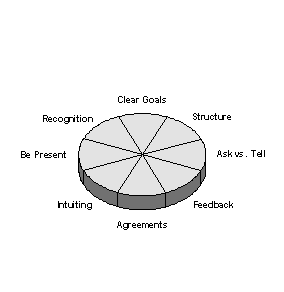
The eight essential elements described below comprise a short-course on how to bring out the best in others. As you practice and apply these coaching skills, they become a part of your natural communication style. Employees and co-workers feel more intrinsically motivated and in charge, have increased commitment to upholding agreements and to doing their best.

The result is increased self esteem and confidence for them, with less effort for you. As coach, you’ll get more done through cooperating with others and you won’t have to come up with all the answers yourself!

Note that these essentials are listed in order of necessity; each skill builds on the previous. You probably do most of these skills most of the time. To help you recognize which of them are your strengths, and where you might be able to improve, I’ve also included how not to do the skill.

Be present: Before coaching someone, pay careful attention to the signals that indicate rapport. The more you can be present, the better you will be as a coach. It would be a mistake to push through resistance or to coach when you are distracted. Instead, being present means being on their agenda, available to what they’re up to, able to let them know you understand their situation, challenges, resistance, fears, etc. Like rapport, this element is foundational to all others.

Clear Goals: Assuming that you and the client are clear on what’s wanted would be a mistake. Set clear immediate goals and long-term direction with “What do you want?” and “How will you know when you’ve got that?”

Ask vs. Tell: Giving unsolicited advice is not only disempowering, it’s unnecessary. Resist the temptation to “give them a fish;” instead, teach them how to fish for their own answers. If you feel compelled to offer advice, it can be packaged in a way that puts the person fully at choice and in charge. For example, try “I have an idea that you might find useful; mind if I check it out with you?”

Agreements: Unclear or incomplete agreements produce misery and suffering. “Oh, you thought I meant this Thursday!?” This also includes effective agreements for how they want to be coached. Clear agreements can contribute to setting an atmosphere of mutual respect and shared power. Effective coaching turns up the volume on accountability to agreements, replacing the need for “command and control.”

Recognition: Mistake: Fake praise or no praise Skill: look for what it is about this person and their performance that’s praise-worthy; be sincere and generously encourage what’s wanted.

Feedback: Let their mistakes be their best teacher. Live by “no failure; only feedback” and only give constructive suggestions for improvement. Learn to gently confront areas that need attention. Separate the person from the issue. Provide both observation and interpretation so you can openly discuss differing perceptions.

Structure: Instead of allowing fire-drills and chaos to rule the day, design reasonable action steps to reach achievable goals. Structures are for supporting, not burdening, the client. They assist the client to remember their commitments, to systematically assess and adjust priorities, to increase their capacity to focus, and to track progress for on-going learning and process improvement.

Intuiting: The opposite of structure. Intuition is different from opinion or interpretation. Intuition usually comes from a “gut feel” or other body signals. An effective coach knows when to throw away the plan, be pragmatic, and how to politely invade or challenge the client’s assumptions to prevent catastrophe.

Most professionals already possess skill at coaching — they just need to understand how and when to use those skills to build trust with others. Managers, executives and team members that gradually add new coaching skills and distinctions to their interpersonal repertoire can get long-lasting, life-transforming results with anyone.

The ultimate goal is to condition the client to use their own resources when you’re not around. And if you think being coached feels good, check out being one.