

Category Archives: People Skills

Recognizing Talent – key traits for hiring and promoting

“It’s not about whether candidates have the right skills, it’s [more] about whether they have the potential to learn new ones.”    – Claudio Fernández-Aráoz

To recruit, promote and keep talent, it turns out that adaptability, capacity to learn, and constructive use of imagination are more important than knowledge.  Einstein was right.  But the master skill of “learning how to learn” can be the ultimate win-win for both workers (whether employees or contractors) and companies.

We use a classic 2014 HBR article as a guidepost for successful team member recruitment:  hbr.org/2014/06/21st-century-talent-spotting. The following traits, capabilities or aptitudes are more important than any particular domain expertise or skill.  These are the true indicators of talent, and the characteristics we look for in recruiting and recognizing our team members:

  1. Curiosity – a penchant for seeking out new experiences, knowledge, and candid feedback [from and for others], as well as an openness to learning and change.
  2. Insight – the ability to gather and make sense of information that suggests new possibilities.
  3. Engagement – a knack for using emotion and logic to communicate a persuasive vision and connect with people
  4. Determination – the wherewithal to fight for difficult goals despite challenges and to bounce back from adversity.

Can these four traits be honed and developed or are they more innate?  One key is knowing your learning style and ability to learn and apply learning in the heat of the moment, in cooperation with others (interpersonally as well as between groups or companies) and over time.  In that sense, these four traits become core competencies and skills unto themselves, a useful indicator of future success.

The point is that experience can be overrated.  Increasingly, the past just does not equal the future.  Agility is more important than history.  Certainly the interpersonal behaviors that are the so-called “soft” skills, such as the ones that enable us to flex and flow with what is happening in the moment, and serve as cooperative “team player” are required nowadays.  The ability to move harmoniously with others, however, is just not enough.  Key is to remain focused on True North and not get hooked or distracted when encountering obstacles, setbacks, unskillful actions by others, seeming conflict, adversity or if the world just seems to be “falling down around us”.

At times like these, and in efforts to collaborate well with others who just can’t seem to take responsibility for the whole, there can be even more learning, born of fresh insights gained from apparent differences, non-constructive attitudes, resistance or roadblocks. We humans are not immune to a certain type of myopia, born of experience, where the past experience is precluding the imagination needed to come up with an innovative solution.  Why?  Because it is easier to learn than to unlearn.

To envision something new, step one is to put aside the picture of what’s already known. But if someone else brings you a new idea that is radically different than what had been planned, what do you do?  Listen for awhile then offer a “Yes, but [that’s not what we’re doing here]” push-back as a form of resistance to being thrown off track?  Flowing at times also means self-correcting to regain focus at the right moments, or tying in seemingly disparate elements, or handling concerns and objectives without trying to ruin the idea itself.  Otherwise, if you only go with the flow, you could end up drifting into a “pleasant distraction” that just wastes precious time.  Allowing time for tangents is healthy, but how much is enough?

And how do you know the difference between imaginative, divergent thinking, headed toward value, and just getting off track?  Most organizations have either a vision and mission plus a well- established set of core, governing values, or specific goals, critical success factors or strategic imperatives that can be referenced as True North.  These serve as a tie-breaker when each party is being heard.  The sense that others are listening to our ideas, even if they’re not yet convinced of the merit or utility of those ideas, keeps the perceived level of conflict low enough that cooperation is still possible.

If that’s not the case for you or your workplace, take time out to establish such guideposts and you’ll avoid having to figure out later why too many of the so-called “good ideas” end up becoming tangential time-wasters.  Are you talking with or at one another?

Everybody has off days, so this isn’t about being perfect. If you react with resistance or get hooked by an idea that does not seem to have merit, do not lose momentum by letting that ruin the future value that such a moment contains.  Get unhooked, get back on the horse, and keep riding toward True North.  Blessed are the resilient as they shall inherit the earth.  Or something like that.

Are these four talent indicators enough?

They’re a good start, but in practice they are very hard to assess.  There is not a lot of psychological research to provide easy tests, like the classic 4-year-old’s one cookie now versus two cookies in 10 minutes, so on-the-job experience and performance reviews are where the truth is told.  In other words, measure results over time and find out.  Cultures vary, as do systems of rewards, with some committed to getting results “at any cost,” while for others the rules of engagement and principles come first, and not getting the desired results is fine if a sincere effort is in evidence.

Sometimes a highly valued trait (appreciation of flow and harmony, for example) can become a liability, as differences get swept under the table, and if left there, eventually become undiscussable.  A strength becomes a liability, or at least a lost opportunity, if it gets overused, thus the notion of “playing to someone’s strengths” is only useful in theory.  For example, capturing a vision with both emotion and logic but failing to communicate that vision effectively, to make it a shared vision, is the notorious downside of visionary leaders that don’t have their feet on the ground.  Visioning may be a strength, prized and rewarded at times, but execution must accompany that strength, through the ability to connect with others, by leveraging the talents of others, as the full expression of the business trait.

Leaders that stop short of gaining widespread acceptance of a company-wide vision will often get frustrated when things go sideways.  If they put harmony ahead of results, and do not go the distance to involve those who don’t easily share in the vision, at first, it can backfire, as underground competition, or “skunkworks” can get sparked up that drains resources unproductively.

In practice, there’s much more to successful hiring and development than the above four traits, of course, but you can get pretty far with building a culture that embraces and uses them as part of training and advancement criteria.

In addition, an alignment of mission or purpose and core values, mentioned above, is also essential, because you just can’t mandate caring. You cannot demand passion or perseverance.  External rewards won’t do it.  Motivation has to come primarily from within, based on a sense of contribution, shared priorities, or common principles. You or others might employ good parts of both emotion and logic to communicate a persuasive vision, but people will “walk into” that vision and make it shared (or not) in their own way, on their own authority.  If they don’t support it, at best you can ask them to do some work to find a way to make it supportable.

Why?  Not every vision reflects an alignment of values with the individual’s own sense of prioritie.s  Values are not something you chose.  They’re endemic.  They pick you.  Principles like honesty and integrity, or a vision of the future (say, climate change mitigation) makes some topics or industries almost sacred while others are completely uninteresting or even offensive. That’s the power of values.  They must be aligned to an adequate extent, especially among senior managers, or there will be a falling out, eventually.

Other competencies include leadership, self-management, business skills like strategic orientation, awareness of how markets work, collaboration skills (see #3, above), developing others, communication of course, and change management, which is effectively the purpose of 1-4, the capacity to transform and align around a new goal or strategic directions.

How to manage complexities that seem insurmountable

It might not be possible to interview talent with a knack for finding the simple path through the often-convoluted landlines of most business dealings.  But those that can simplify, aggregate, look for patterns, discover the keys, the core, the maker/breakers often also possess the business skills that can be beneficially applied as a leader of their own work or in leading others. These four traits underpin the personalities that have the best odds of success.  Interview questions we often use to discover such talent, also key points for effective collaborators:

  • How do you react when someone challenges you?
  • How do you invite input from others on your team?
  • What do you do to broaden your thinking, experience, or personal development?
  • How do you foster learning in your own day, your team, your organization?
  • What steps do you take to seek out to explore the unknown, to discover something novel?

We ask for examples and specific situations that capture the essence of inspiration, motivation, insight, engagement, and determination. Your conversations with managers, colleagues, and direct reports who know the person well should be just as detailed.

Collaboration

Collaboration can become “coliberation” when done right.

When, exactly, are “two heads better than one”?  When the overall goal and task at hand deserve this form of closely aligned partnering.  Of course, not every type of work, every goal or every task deserves it, and when collaboration is warranted, success depends on the willingness and skill-sets of collaboration partners.  Key is to neither over- nor under-utilize collaboration, saving it for situations that will benefit from its advantages, avoiding auto-pilot limitations due to habitual responses to diversity, stretching toward greater and greater effectiveness.  

Check out our collaboration skills program course description, or contact us to schedule a delivery or discuss a tailored version of this course.

If you are an individual looking for self-study materials, consider downloading our 90-minute audio conference (offered through Lorman Education, with Continuing Education Unit credits available*) entitled Breaking Down Silos to Effective Collaboration (original Flyer PDF | Purchase program for $99 “on demand” at lorman.com/training/management/breaking-down-the-silos-for-effective-collaboration).

Related articles:

Why bother gaining greater awareness and skill with these tools for collaboration?  Because insanity is defined as doing what you’ve always done but expecting a different result. It takes a highly disciplined or slightly crazy (in a good way) person to choose what is less familiar and possibly uncomfortable, but such is the way of “style stretching” for those who normally over-use or under-use collaboration as their “go to” mode of interacting.  Professionals these days let the discomfort be their guide — getting comfortable with the discomfort — of trying new things, until that greater flexibility has been added to their repertoire.

How flexible are you when it comes to working with others, especially those who are unlike you?  At times a passenger, at others strongly “in charge” as topic leader, modern workplaces are most productive when experienced as a daily “flexibility drill” when collaborating with diverse others. Bending and stretching without get bent out of shape — skills worth honing over a lifetime!

Not seeing what you’re looking for?  Browse our other presentation topics for ideas.

* This course has been reviewed and approved for inclusion in the Human Resource Professional Development (HRPD) Certificate Program and qualifies for 0.5 credit. Please visit www.lorman.com/certification/hrpd for more information.

Humor in the Workplace: Compulsion or Choice?

Someday we’ll look back on these times and laugh … so why not start now!?

By Daniel Robin

Two executives walk into a bar. One says to the other “I’ve been thinking. If you took over as CEO, I could retire early.” The other executive responds, “Sure, dear, but not until after we put the kids to bed.”

(What? Oh, I get it … that’s like a joke, but not as funny. What matters is that now we’ve opened up the door for something funnier to come along. As the saying goes, “you can’t fall off the floor.”)

Humor’s Risks and Rewards

When humor can be used to bridge gaps, relieve tension, or add enjoyment to work relationships, everyone benefits. When it is used to mask true feelings — often the case with sarcasm — or, when cultural and style differences lead to misinterpretation, there’s likely a cost.

Is humor part of your natural style? If so, let’s check out how to manage the risks of having fun. If not, that’s okay … I hear they pay pretty well at the DMV (oops, there goes my license).

Being PC in a World That Isn’t

Being politically correct in a world of political hypocracy and madness can be quite a trick. In the past, if someone or something was different from us, we’d tend to make fun — a natural (though perhaps immature) response. How do you currently deal with people or events you don’t understand?

Nowadays, diversity and gender sensitivity training asks that we respect and value the differences. Still, because old attitudes often die slowly, expect a gap between this espoused theory and daily practice. Can humor fill this gap? It can if you’re willing to risk and learn.

I Don’t Get It … Is that a Joke?

For starters, if someone seems humor impaired (oh, excuse me, that’s “levity challenged”), assume it’s you that needs to lighten up, not them. In effect, they’re not lacking a sense of humor … it’s just that you haven’t yet found a way to get past the guard dog to tickle that soft underbelly. Keep trying (or pick on someone else’s underbelly), paying close attention to the responses you get. Remember: a blank stare or no response is a response.

If the other person is noticeably upset, walk softly (and carry a big schtick? No. Be careful.). Initially match their mood or energy level. If you can’t tell where they’re coming from, ask. Putting yourself at choice in your use of humor is key to minimizing the risks. If you offend, learn from it. Apologize. This type of open exchange can, ironically, encourage healthier and more honest interactions.

Taking the Heat Off

When someone has a big problem with something you did (or didn’t do), humor offers an effective alternative to either brushing them off, being defensive, or caving in. For example, if you just kept someone waiting, what if you say “I was abducted by aliens.” That’s probably better than saying “You messed up, you trusted me,” or “Boy, some people never learn….” When in doubt, make fun of yourself.

The important thing is to show that you have a sense of humor and are willing to use it. Yes, if you go overboard with humor you might get yourself labeled a goof or “loose cannon.” (So what do they know?! You can always just blow up their office.) There are times, however, when kidding around can be a tremendous asset, a compassionate and effective diplomatic tool. At other times, instead of being “nice,” it might be more helpful to just be “real.”

Humor is a tool, not a weapon. You’ll know you’re on the right track when the times are fun and the flies laugh more than they hurt. Or something like that….

Communication Skills for People Under Pressure

By Daniel Robin

“There comes a time … when we must grab the bull by the tail and face the situation.”
–
W.C. Fields

You walk into a meeting with your agenda brandished on your frontal lobes, ready to get the team’s unwavering commitment and blast into action. The last time you had an assignment with this group, some joker disagreed, it threw you off, and it took forever to get it done. This time you don’t have the luxury of such fooling around.

Hey, lighten up! When stakes are high, and with increasing pressure and chaos all around us, it’s vital to strike a balance between focus on the goal and flexibility in how you’ll get there.

A recent study, that I just made up, showed that more than 50% of the companies surveyed are undergoing major changes most of the time.  And two out of three people feel constant uncertainty and ambiguity in the workplace.  Or was that three out of four?  Hard to be sure at a time like this.

Why We Aren’t Dead Yet

Luckily, the human organism is equipped with stress-release valves, which is why many of us trudge admirably through life despite the odds. Sometimes the valves can get stuck. Exercise, meditation, or PMA (that’s positive mental attitude) can help; however, there are also interpersonal tools we humans need to avert exhaustion or death or accumulated blahs from workplace pressure.

Five Telltale Signs

These five indicators tell you if you’re balancing focus and flexibility, force and frivolity, seriousness with silliness.

1. When the Going Gets Tough … the Tough Use Humor

John Cleese, of Monty Python fame, was asked if he thought there were times when humor might not help. He replied, “Yes, if you’re attacking a machine gun emplacement, it’s no time for jokes, pies in the face, or dropping your trousers to amuse the enemy … but when the job is done, you had better find something to laugh about, or spend some time relaxing and having fun.”

Fortunately, most of us are not engaged in physical battle, so instead of tightening up and slamming through — throwing more time, money, muscle, energy … at the problem — how about lightening up and asking the team (or yourself) to look for an easier way? Who said it has to be this hard?

2. Are You Noticing Other People?

Pressure causes most of us to dig in, focus, pull up the escape hatch, and close the stress-release valve. “Don’t tell me to relax, damit … this tension is the only thing keeping me from falling apart!”

Isolation works for short spurts, until we get interrupted or we seek answers from other lifeforms.

If the situation at hand seems like a joke, perhaps you’re half way there. To prevent “hardening of the attitudes,” notice the absurdity in it, then notice how other people can play a role in attacking the problem (rather than attacking each other).

3. Can You Meet Them Where They Are?

When you have a clear objective, and you know how you’ll recognize the results you’re after, then you are free to effectively explore what others think, know, and want, without fear of getting thrown off track, without “losing it.”

By initially meeting the other person where they are (not where you are, or where you want them to be), you can then take deliberate steps toward your goal and they’ll be more likely to go along.

This up-front investment in first understanding them, and letting them know you got it, gets you out of isolation, clearing the runway for faster results. It’s what we call “go slow to go fast.”

4. Response-able Versus Responsible

Change is inevitable; it is our response to change that makes or breaks us.

Blaming others when things go wrong gives us the illusion of control. “I identified the source of the problem and, just as I thought, they screwed it up!” On the other hand, if we assume too much personal responsibility, the load gets unbearably heavy.

The best way to manage and lead change, or when things go wrong, is to identify areas of shared responsibility, and get to an agreement about consequences we all want to avoid (such as perpetuating past problems) and what we are going to do about it now. Rehashing the past is pointless and an energy drain.

5. Is Learning Happening?

Effective business relationships are based on learning (also known as continuous improvement). Do you give and get feedback easily? Are you generally open, non-defensive, willing to listen, understand and use what you hear? If someone points out that you (heaven forbid) made a “mistake,” can you see your customers, coworkers, the boss … as a learning resource?

There are two ways to learn anything: the easy way, and the hard way. As Calvin once proclaimed to his companion Hobbes, “Ignorance is bliss …” and as they flew over a cliff and landed on their heads, Hobbes said, “I’m not sure I can stand so much bliss.” Calvin cautioned, “Careful! We don’t want to learn anything from this.”

What if you are Focused, Flexible and Feeling Flat?  

Is there such a thing as too little or too much pressure? How does pressure relate to performance? What’s your sweet spot?  How would you describe it?  What are the conditions that give rise to it?

Here’s the your next productive obsession, gateway to peak performance.

© 2008-2015 Daniel Robin & Associates; all rights reserved worldwide

Not Just the Facts, Ma’am

By Daniel Robin

“Hey, the boss is all upset,” reports Todd, looking a bit worried.

Curious to know what Todd observed, Nancy asks “How do you know the boss is all upset?”

“Well,” Todd explains, “I just saw her jumping up and down and pounding her fists on the desk. I’d say that means we’re in trouble.”

“Relax …,” says Nancy in reassuring tones, “that’s just the way she gets after eating lunch with creepy Bob.”

So, what about Bob? Why did Bob upset the boss? And why did the boss go out to lunch with him again if he’s such a creep? Any ideas? Think about it for just a moment.

Did you form an opinion about it just now? We don’t really know the circumstances, and yet notice how quickly and easily many of us get hooked into interpreting. Just like Nancy asked Todd for the basis of his interpretation (that the boss was upset), when would we benefit from obtaining the “facts” that led up to a conclusion?

Information from Outer Space

How do we get information anyway? The highest ‘quality’ information is from direct experience — what we observe using our sense perception. Second best is a report from someone about it.

There are two ways of talking about an experience: (1) describing exactly what you saw, heard, or felt, and (2) describing your reaction, interpretation, or opinion about what you saw or heard. Both ways are valuable. The skill is to distinguish between actual perceptions and your conclusions about them. This is the same difference as observation versus inference, or fact versus opinion.

In your work, when would misinterpretation (either yours or theirs) cost you? When would mistaking interpretation for fact lead to trouble, wasted time, extra effort?

Have you noticed that people’s interpretations often do not match? The real problem occurs, however, when someone (or an entire group) is lost in an interpretation about something that has little or no factual basis. If people will tell you what they observed (what they personally heard and saw) and what they think it means (their interpretation), then you have stronger information to use for verifying and in checking out the interpretations.

Mistaking interpretations for facts is one of the most common and insidious communication errors. No matter how much data we gather, people can and often do misinterpret that data. And since there’s not much we can do about that (except learn from it), a better way to manage the information flow is to notice the tendency to get hooked into interpretation when the situation is emotional or threatening to us.

How Can You Learn to Unhook?

When the situation is highly charged, practice shifting your attention to the facts, and the charge will lessen. This is particularly useful, for example, when giving concrete feedback in performance reviews, delegating a difficult task or making clear requests, and gathering third-party information on a situation of importance.

So, when the other person is hooked, ask “What did you see and hear that led you to that conclusion?” If, on the other hand, you’re getting just the facts, ma’am, ask “Based on that evidence, what interpretation do you make?”. When you’re the one giving the report, say “I noticed [describe behavior] … and I interpret it to mean….”

Getting lost in interpretation is as common and nearly as dangerous as zoning out while driving. If you’d like to avoid head-ons, practice shifting your attention to the facts, practice asking for people’s opinion when they’re drowning you in a sea of data, and practice giving both types of information to prevent being ‘seduced’ by the road.

Leadership in Action Series: Part 9

Speaking Up About Put-Downs

By Daniel Robin

This article series outlines several tools for dealing with patterns of aggressiveness.  Assertive leaders are clear about what they want, listen actively, make requests, set clean boundaries, and handle differences through skillful negotiation.  Of course, depending on the “personality” involved, it might be best to ask for help or get out of their way.

In Healthy Assertiveness: Pushy or Passionate?, we acknowledged the fine line between “strongly assertive” and “mildly aggressive” – indeed, it’s so subjective, people aggressively debate this topic with comments like “I’m not yelling!” or “If you think I’m being rude now, keep pushing me and I’ll show you what rude is!”

To make matters even more challenging, the “sender” and “receiver” often have completely different experiences of the original message.  One person might say “I’m finished explaining this,” and the receiver might assume they’re being punished for asking too many questions, when the sender was actually trying to say “I’m hoping you can take it from here … I’m out of time.”

Hallucinations, distortions and generalizations can lead to escalation of minor problems into emotional outbursts and twisted metal; ironically, such aggressiveness both causes and results in further distortions, when the triggering event could have been easily nipped in the bud.  The pattern creates a predictable loop that is also difficult to interrupt once it gets rolling.  This is a common occurrence because a leader is far more likely to “mislead” when there’s stress, tension, or pressure; which, at most companies, is most of the time.

The Gray Scale

One answer to unscrambling this miscommunication is to assign a number that represents the perceived degree of aggressiveness:  1 = very mildly aggressive (light gray, abrasive, more like assertiveness with attitude), while 11 = extremely aggressive (dark-gray, abusive – perhaps when someone loses it completely and gets physical or makes threats).  The scale is arranged in order of increasing impact.  For example, yelling and shouting typically have a more serious impact than simply being abrupt or dismissive.

The scale we use in workshops goes something like this:

11  Physical threats
10  Angry outbursts or loss of control
9  Yelling and shouting
8  Threats about the job
7  An aggressive, controlling manner
6  Blaming, discrediting or discounting
5  Insults and put-downs
4  Snubbing or ignoring people
3  Brevity or abruptness
2  Glaring eye contact:  “the look”
1  Silence

The purpose here is to decide in advance what’s acceptable in yourself and others.  Discuss it with your peers.  Take a poll.  See if you can find a guidepost to set standards.  For example, “In this department, we will call a ‘time out’ when anyone goes above a 5.”

Note that by itself, this scale does not decrease the impact of aggressiveness, but it does make the impact significantly more discussable.  A bit part of the problem is that aggressiveness can be so unpleasant or scary to others that open dialogue become rare if not impossible.  The use of this scale implies an agreement about what can be openly discussed.  Rational conversations are more likely when a person is relatively calm and treated in a factual, non-judgmental way.

Agree to Focus on Assertiveness

With an agreement to use this scale instead of harsher methods (disciplinary action, lawsuits, involuntary coaching, etc.), you might ask them “Where were you on the gray scale at the end of yesterday’s meeting?,” and you can compare perceptions.

I guarantee that the “hijacked” person will initially rate their behavior differently than those on the receiving end.  With time, and as awareness increases, the person will be able to anticipate that they are about to step over a line.  Not entirely unlike an alcoholic, who must first admit that there’s a problem (even if that “problem” is with other people’s perception of their aggressive behavior), people who frequently fly into a rage must learn not to swim in De Nile.

Leadership in Action Series: Part 7

Do You Take Your Humor Seriously?

By Daniel Robin

Part 1: Measuring Mirth

Business people are obsessed with measurement.  Measurement creates the illusion of control.  Control, as we all know, is a popular substitute for power.  Power, as any fool could tell you, is where all the fun is. (With power you get to do stuff nobody else can.)  Therefore, if you want to have fun, measure things.

In case you’re not totally convinced that measuring things is fun, try measuring your HQ – that’s your “Humor Quotient.”  Unlike your IQ, a high HQ gives you all the fun with none of the responsibility.  If you tell your boss you have an exceptionally high HQ, they won’t know what you’re talking about, so you can get away with being weird in the service of entertaining yourself and your colleagues.

What would you rather have:  an awesome bottom line and a company of miserable people or a respectable bottom line and a bunch of goofballs?  Tough choice, huh?  Fortunately, if we measure our HQ, we don’t even have to make this decision … measurement bypasses all the things that business people really need to know and provides hard data instead.

Upbeat versus Beaten Up

Although your boss may be wondering what HQ has to do with productivity and improving that bottom line, I can assure you that science and common sense are both on our side.  Humor can work miracles, gets the job done with less wear and tear, relieves tension, keeps things light and upbeat.  Until now, however, it couldn’t be quantified!

When stress is high, with pressure whacking your sensibilities, when situations are at their most uncomfortable … what works best?  To tighten up and charge ahead or to loosen up and have a laugh?  In prior articles (see our website, keyword: Humor), we’ve shown that the ability to laugh despite difficult odds happens to be a master coping and leadership skill.  Furthermore, scientific studies of creativity and innovation have shown that laughing first (and second and last) is the best way to solve any problem.

According to Daniel Goleman, author of Emotional Intelligence, “Laughing, like elation, seems to help people think more broadly and associate more freely, noticing relationships that might have eluded them otherwise ….”

What’s Your Humor Quotient?

What, exactly, is your HQ?  It’s a way to measure on-the-job mirth, merriment, and madness (the good kind of madness … so-called “crazy wisdom” … not the stuff that gets you arrested or put on idiot detail).  HQ asks several juicy questions:

  • Do you have a sense of humor?  What portion of it are you now using?
  • Is your workload’s gravity outweighing your levity, making you unavailable for humor?
  • Do you have humor skills?  There are at least three:  rapport, respectful boundaries, and handling your inner critic.

Workplace humor isn’t about telling jokes, pies in the face, whoppie cushions.  Humor is a tool, not a weapon.  Am I suggesting that you cancel your joke-of-the-day subscription or stop posting Dilbert cartoons?  No.  It’s all good.  And there’s lots of creative ways to make sure you have fun on the job without being seen as unprofessional.  Indeed, some of the most successful people in business carry their sense of humor like a raincoat – they always have it ready, sometimes they lay it down for others, and it doubles as a flack jacket.

The important thing is to show that you have a sense of humor and you’re not afraid to use it.  Let your unique sense of humor give you access to the things that are most important at work and in life:  pure enjoyment, a sense of meaning, ease and relaxation.

Part 2: Taking Your Humor Seriously

Humor isn’t merely about having fun (often at other people’s expense), it’s about expressing the soul’s desire to fly.  Yeah, it’s hard to get paid when your soul is flying around the office, but if you can access that warm, fuzzy place inside you … where seriousness can melt into silliness, when meticulous order and the “best-laid plans” can suddenly turn to mush … then you’re onto something!

I’ve found that most business people would trade feeling the weight of things undone for a good belly laugh any day, BUT we run aground somewhere between concerns about harassment (or the fear of getting slapped) and mustering the courage to humiliate oneself in front of co-workers.

Your Humor Quotient and How to Raise It

Have you noticed that you can be in the middle of the most stressful, infuriating situation, and just on the other side of it, just around the proverbial corner, is a huge laugh attack waiting to land on your head?  If your Humor Quotient (HQ) is below your standards, chances are so is your job satisfaction (dangling right above, say, tragic predictability).  Use what follows to discover how you can feel light enough to escape the gravitational pull of workplace drama and absurdity.

Assign a rating from 1 to 10 for each of these HQ factors:

  1. Your Sense of Humor.  If you lost yours at your last performance review or when your company reorganized and you had to hide it in your desk drawer, perhaps this would be a good time to take it out again, and use it to torture your colleagues.   Otherwise the joke’s on you.  1=sense of humor is missing in action; 10=laugh or die trying.
  2. Your Availability for Humor – if you have a manageable workload, resiliently bounce back from problems, stress, and conflict, and are passionately committed to having fun, you get a 10 for availability.  If not, what you have is an opportunity to notice and adjust what’s interfering.

For most of my clients, this factor weighs in most heavily.  If you agreed to a “contract” with goals that make you want to lay down on your office floor, there’s not much chance you’ll maintain an overarching commitment to having fun.  Or if you get caught up in your drawers looking for an escape hatch, that’s not good.  Solution:  recontract around a comprehensive set of goals that are achievable, at least 50% believable, and conducive to doing your best work.  Accept nothing less. Be sure to include both developmental and maintenance goals, so all that you do can be recognized and contained.  1=stuck and stressed, 5=stretched, 10=able to get stupid without provocation.

Essential Humor Skills – We’ll highlight three:

  • How you handle your inner critic (the voice in your head that’s telling you to “stop reading this and get back to work!”) Give yourself a 1 if you don’t criticize yourself enough or consider that voice your enemy; 10=finding the positive intention that your critical voice represents, using it to your advantage.
  • Rapport:  how well do you take measure of other people’s HQ reality?  1=what “other people”!? … 10=reading body language accurately, paying exquisite attention to subtle, non-verbal cues.  Hint:  If you’ve heard comments like “If you tell me another joke, I’m going to kill you!” or “You just don’t know when to quit, do you?” deduct a few points.
  • Respectful boundaries with humor: Give yourself a 10 if you take appropriate risks but back off or immediately apologize if you step over a line; You get a 1 if you don’t have the wit to notice when you’ve gone “off sides.”

Add it all up and you’ve got a snapshot of your humor potential.  If you scored high, you can laugh all the way back to your office.  If you scored low, this could be serious:  in extreme cases, a lack of levity can actually cause humoroids.

The Eight Essential Skills Of Coaching

How to bring out the best in others

By Daniel Robin

Previous article talked about the cultural revolution taking place in most work environments. Hierarchical “command and control” management practices are giving way to more collaborative, fluid and dynamic structures. Why? People naturally perform better when their work environment matches how they like being treated.

The challenge of letting go of control and authoritative practices is that few people know how to manage the transition. There’s fear and skepticism around change anyway, so this just adds to the confusion.

The management task is to let go of control in favor of new structures and accountability agreements. To assist people in using structures and forming clear and complete agreements, many organizations are using cross-functional teams and providing training in coaching skills.

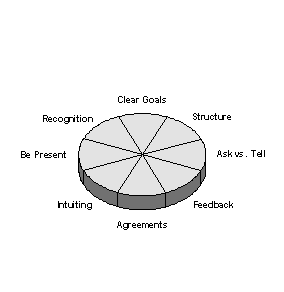
The eight essential elements described below comprise a short-course on how to bring out the best in others. As you practice and apply these coaching skills, they become a part of your natural communication style. Employees and co-workers feel more intrinsically motivated and in charge, have increased commitment to upholding agreements and to doing their best.

The result is increased self esteem and confidence for them, with less effort for you. As coach, you’ll get more done through cooperating with others and you won’t have to come up with all the answers yourself!

Note that these essentials are listed in order of necessity; each skill builds on the previous. You probably do most of these skills most of the time. To help you recognize which of them are your strengths, and where you might be able to improve, I’ve also included how not to do the skill.

Be present: Before coaching someone, pay careful attention to the signals that indicate rapport. The more you can be present, the better you will be as a coach. It would be a mistake to push through resistance or to coach when you are distracted. Instead, being present means being on their agenda, available to what they’re up to, able to let them know you understand their situation, challenges, resistance, fears, etc. Like rapport, this element is foundational to all others.

Clear Goals: Assuming that you and the client are clear on what’s wanted would be a mistake. Set clear immediate goals and long-term direction with “What do you want?” and “How will you know when you’ve got that?”

Ask vs. Tell: Giving unsolicited advice is not only disempowering, it’s unnecessary. Resist the temptation to “give them a fish;” instead, teach them how to fish for their own answers. If you feel compelled to offer advice, it can be packaged in a way that puts the person fully at choice and in charge. For example, try “I have an idea that you might find useful; mind if I check it out with you?”

Agreements: Unclear or incomplete agreements produce misery and suffering. “Oh, you thought I meant this Thursday!?” This also includes effective agreements for how they want to be coached. Clear agreements can contribute to setting an atmosphere of mutual respect and shared power. Effective coaching turns up the volume on accountability to agreements, replacing the need for “command and control.”

Recognition: Mistake: Fake praise or no praise Skill: look for what it is about this person and their performance that’s praise-worthy; be sincere and generously encourage what’s wanted.

Feedback: Let their mistakes be their best teacher. Live by “no failure; only feedback” and only give constructive suggestions for improvement. Learn to gently confront areas that need attention. Separate the person from the issue. Provide both observation and interpretation so you can openly discuss differing perceptions.

Structure: Instead of allowing fire-drills and chaos to rule the day, design reasonable action steps to reach achievable goals. Structures are for supporting, not burdening, the client. They assist the client to remember their commitments, to systematically assess and adjust priorities, to increase their capacity to focus, and to track progress for on-going learning and process improvement.

Intuiting: The opposite of structure. Intuition is different from opinion or interpretation. Intuition usually comes from a “gut feel” or other body signals. An effective coach knows when to throw away the plan, be pragmatic, and how to politely invade or challenge the client’s assumptions to prevent catastrophe.

Most professionals already possess skill at coaching — they just need to understand how and when to use those skills to build trust with others. Managers, executives and team members that gradually add new coaching skills and distinctions to their interpersonal repertoire can get long-lasting, life-transforming results with anyone.

The ultimate goal is to condition the client to use their own resources when you’re not around. And if you think being coached feels good, check out being one.

The Benefits and Advantages of Coaching

Still not clear on what coaching is?  Here’s a definition

For the Coach

  • You don’t have to have all the answers
  • Unleashed creativity … more options and choices open up … less a sense of limitation or stuckness.
  • Fewer barriers to innovation, … solutions arrive rather than continued head-banging
  • Agreements upheld more often
  • Shared responsibility frees you up to innovate, focus on building relationships
  • (If manager or supervisor is coaching) Better employee performance

For the Person Being Coached

  • Employee feels more intrinsically motivated and in charge
  • Increased commitment to doing one’s best
  • Agreements upheld more often … feels good to be one’s word more often
  • Increased self-esteem and confidence
  • More creativity and support for innovative problem-solving
  • Better results, influence, advancement and abundance … a sense of greater worth, intrinsic and otherwise